
- By YANCHAO
- 2026-09-21
- Beginner's Guide
How to Ship from China to the USA, Step by Step (2026 Guide)

To ship Taobao, 1688 or other Chinese-store purchases to the USA, screen the goods before buying, use your unique China warehouse address on every order, review each arrival, consolidate compatible parcels, and choose a route only after the packed weight and dimensions are known. Then declare every item accurately, confirm the customs terms, pay and track the shipment.
This guide explains the process for personal purchases using YANCHAO's China warehouse. It was reviewed on 21 September 2026. Route prices and availability can change, so use the live calculator for the final quote.
Check current China-to-USA routes
The complete process at a glance
The shipment is easier to manage when it is treated as three connected journeys: seller to China warehouse, warehouse handling, and China warehouse to the US address.
| Stage | Your task | Warehouse or carrier task | Common failure |
|---|---|---|---|
| Before purchase | Check the exact product and create an account | Provide a warehouse address and unique user ID | A restricted product is bought before anyone checks it |
| Chinese checkout | Copy the full warehouse address into each store | Receive parcels from different sellers | Missing ID makes an arrival difficult to match |
| Domestic tracking | Submit each Chinese tracking number | Match the parcel and create an arrival record | One marketplace order is split into several packages |
| Warehouse review | Check photos, quantity and visible condition | Record, photograph and store the eligible goods | A wrong size or missing item is discovered too late |
| Consolidation | Choose which parcels travel together | Remove redundant packaging, protect and combine items | Incompatible goods are packed for the wrong route |
| Route booking | Compare final chargeable weight, cargo and deadline | Pack, weigh, measure and offer eligible services | A seller's estimated weight is used as the freight basis |
| Customs and delivery | Declare each item and keep the evidence | Tender the parcel, clear under the selected terms and provide tracking | A vague declaration or incomplete address delays the shipment |
1. Check the product before paying the seller
The first shipping decision happens in the shopping cart, not at the warehouse. An ordinary T-shirt and a skincare liquid may arrive at the same China address, but they do not necessarily qualify for the same US route.
Start by placing the product in one of three groups:
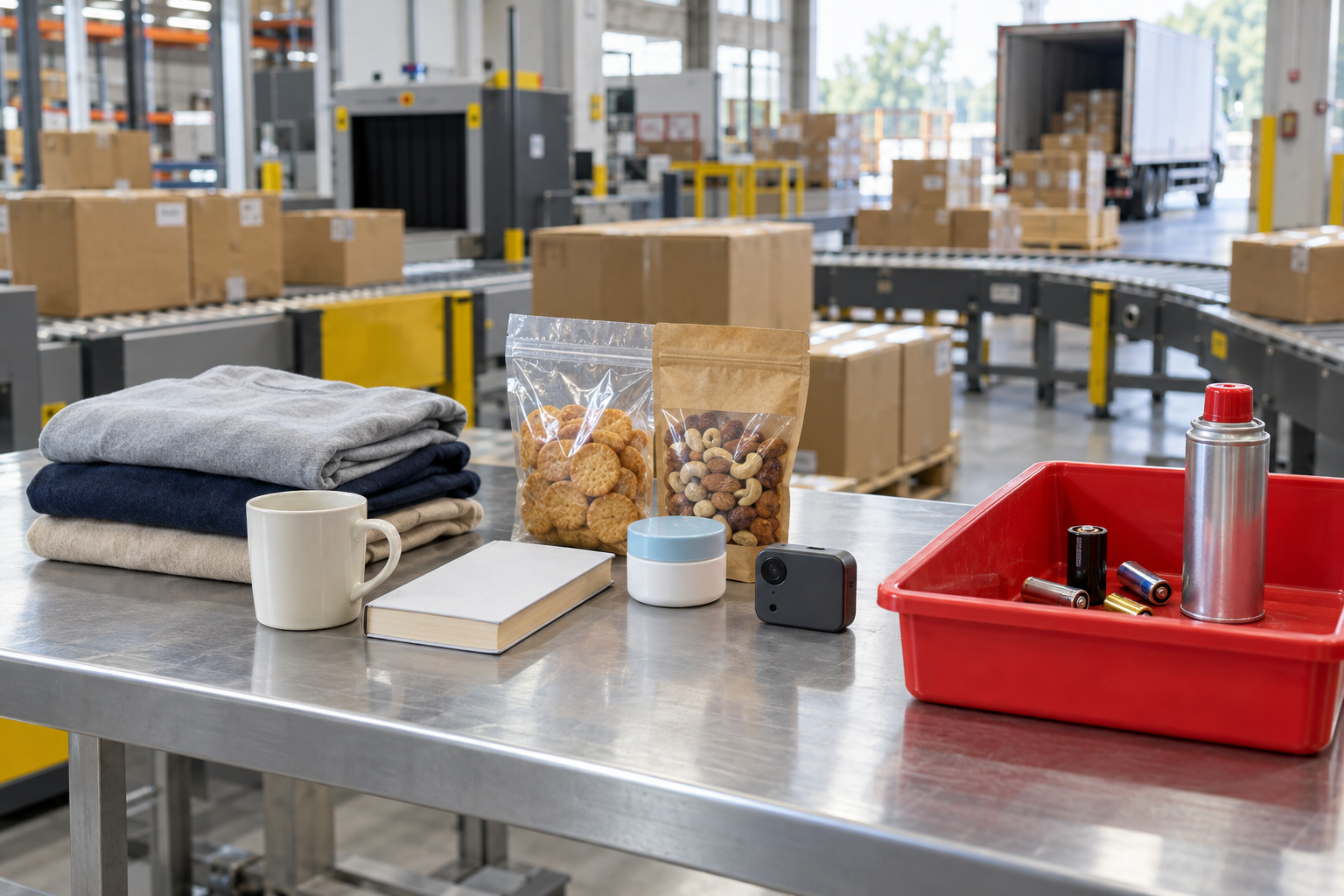
- General goods: ordinary clothing, bedding, books, kitchenware and many household products without batteries, magnets, liquids or brand concerns.
- Sensitive goods: packaged food, cosmetics, liquids, powders, medicine, knives, wood and products with a battery installed inside them. These require a compatible route and product review.
- Refused goods: loose batteries, power banks, outdoor power stations, alcohol-based perfume, aerosols, cigarettes, fresh food, live plants, seeds, counterfeit goods and other prohibited items must not be sent to the warehouse.
Carrier acceptance and US admissibility are separate checks. A route may be equipped to carry “food” while FDA or USDA rules still restrict the ingredients. Use the full US goods-eligibility guide when the item is not clearly ordinary cargo.
If the listing is vague, ask the seller for a clear photo of the ingredients, material, battery label or product packaging before checkout. That is easier than paying for a domestic return after the parcel reaches the warehouse.
2. Create your account and save the China warehouse address
Register before placing the Chinese orders. Your account provides a warehouse recipient, phone number, full Chinese address and a unique user ID. The ID is what connects a domestic courier parcel to your account when many customers use the same building.
Copy the address exactly as displayed. Save it in the address book of Taobao, 1688, JD.com or the store you use. Do not remove the ID because the checkout field looks crowded, and do not reuse another customer's recipient details.
Eligible purchases from several stores can all arrive in the same warehouse account. They do not need to become separate international shipments unless their cargo types, timing or packing needs are incompatible.
3. Place the orders and record every domestic tracking number
At Chinese checkout, select the saved warehouse address and verify the recipient, telephone number, district, street details and user ID before payment. Store screenshots of the order, product page and amount paid; they may be useful for inspection, declaration or a later claim.
When the seller dispatches, submit the Chinese domestic tracking number in your YANCHAO account. Use one record for each physical parcel. A single marketplace order can be split across warehouses or dispatch dates, so compare the store's shipment count with the arrivals shown in the forwarding account.
If you cannot complete Chinese checkout yourself, purchasing support is a different service path. Confirm the product, variation, quantity, domestic shipping charge and return conditions before an agent places the order.
4. Wait for warehouse check-in and review the arrival photos
YANCHAO normally checks a signed domestic parcel into the account within 48 hours. Chinese public holidays, missing IDs and concealed recipient details can slow matching.
Do not move straight from “arrived” to international packing. Review the parcel count, item photos and warehouse notes. Check the colour, size, quantity and visible condition against the original order. A photograph cannot prove that every electronic function works, but it can expose a wrong item, obvious damage or a missing unit while a China domestic return may still be available.
If the Chinese courier says delivered but no record appears after the normal check-in period, provide the tracking number and order screenshot so the warehouse can investigate. Guessing from the product name is less useful than the actual domestic number.
5. Decide what to consolidate and how it should be packed
Consolidation is not simply “put everything in one box.” Combine goods that can use the same route and tolerate the same packing method. Clothing, books and sturdy household goods are usually straightforward. Liquids, food, fragile items and electronics may need separation, leakage protection or a different service.
YANCHAO currently provides 180 days of free storage, allowing orders from several sellers to accumulate. Once the intended purchases have arrived:
- select the parcels that should travel together;
- remove redundant seller cartons where safe;
- request compression for suitable soft goods;
- add protection for fragile products;
- keep retail packaging when it is needed for identification, ingredients, warranty or safe transport.
The smallest box is not always the best box. Removing necessary protection can reduce volume but increase damage risk. The useful target is the smallest safe final carton.
6. Use the packed carton—not the shopping-page weight—to estimate cost
The international charge normally uses the greater of actual weight and volumetric weight. For the current US routes in this cluster, the working divisor is 6000 unless the selected quotation states otherwise.
Volumetric weight (kg) = length × width × height in centimetres ÷ 6000
A 60 × 40 × 40 cm carton has a volumetric weight of 16 kg. If it weighs 10 kg on the scale, its provisional chargeable weight is 16 kg.
The estimate before consolidation includes seller packaging and incomplete measurements. After packing, the warehouse weighs and measures the outbound carton. The final route, chargeable weight and payable amount should be checked against those outbound figures.
What one real packing record shows
An anonymised YANCHAO shipment to West Covina, California, used the US special-goods sea route. Before final packing, it showed 50.440 kg actual weight, 61.969 kg volumetric weight and 61.969 kg chargeable weight. After packing, the figures were 23.040 kg actual, 24.106 kg volumetric and 24.106 kg chargeable.
The recorded chargeable weight fell by 37.863 kg. The parcel left the warehouse on 3 August 2026 and was confirmed received on 27 August 2026. Its paid amount was CNY 1,085 after a CNY 50 new-customer coupon.
This is one historical parcel, not a promise that repacking will reduce every shipment by the same amount. The original orders, product mix and carton arrangement determined the result.
For current rate formulas and more weight examples, use the China-to-USA shipping-cost guide.
7. Select an eligible air or sea route
Route choice starts after the goods and packed carton are known. Remove any route that does not accept the cargo, minimum weight, carton dimensions or destination ZIP code; then compare cost and estimated transit time.
| Situation | Route family to check first | Current planning window |
|---|---|---|
| Smaller urgent general-goods parcel | US air, general goods | 8–12 days |
| Eligible food, cosmetics, liquids, powders or built-in-battery goods | US promotional fast air, special goods | 7–12 days |
| Eligible parcel at or above 11 kg that still needs air | US economy air | 14–18 days |
| General goods at or above 21 kg with a faster sea target | US express sea, 21 kg minimum | 20–25 days |
| General goods at or above 13 kg with more time | US economy sea, 13 kg minimum | 30–35 days |
| Small, non-urgent general-goods parcel | US economy sea, 1 kg minimum | 30–35 days |
| Small general-goods parcel needing faster sea | US express sea, 1 kg minimum | 20–25 days |
| Eligible special goods at or above 15 kg | US special-goods sea | 35–45 days |
These are YANCHAO route estimates reviewed on 21 September 2026, not guaranteed delivery dates. All eight named services in the supplied route snapshot were listed as DDP. Do not extend that statement to EMS, DHL or another unlisted service: verify the exact customs arrangement shown at checkout.
The air-versus-sea comparison explains the route minimums and same-weight calculations in more detail.
8. Declare every product in plain, accurate language
The declaration should let a customs reviewer understand what is inside without opening the shopping link. Use the actual product name, material or ingredient where relevant, quantity and transaction value. Keep the invoices or order screenshots.
CBP's cargo-description guidance says generic terms such as “accessories,” “online retailer goods,” “general cargo” and “miscellaneous” are not precise enough. Use descriptions like these instead:
| Too vague | More useful description |
|---|---|
| Clothes | 2 men's cotton T-shirts and 1 polyester jacket |
| Accessories | 6 plastic hair clips |
| Skincare | 2 facial moisturisers, 50 ml each |
| Electronics | 1 pair of wireless earbuds with installed lithium-ion batteries |
| Food | 4 sealed packets of wheat biscuits, 300 g each |
Do not hide a sensitive product under a general description and do not lower the value to chase a customs threshold. DDP does not make a false declaration acceptable.
FDA states that products offered for US entry, including personal-use products, must be declared to CBP. Food, medicine, medical devices, cosmetics and other FDA-regulated goods can receive additional review. If the product falls into one of those groups, keep the label, ingredient list and any required prescription or supporting document available.
9. Verify the US address, insurance, customs terms and final invoice
Before payment, read the finished shipment from top to bottom. Confirm the recipient's full name, street number, apartment or suite, city, state, ZIP code and reachable telephone number. A correct country with a missing unit number is still an incomplete delivery address.
Then verify:
- every item appears in the declaration with quantity and honest value;
- sensitive goods have written approval for the selected route;
- actual weight, dimensions, divisor and final chargeable weight are visible;
- the route name, estimated transit and DDP/DDU terms match the quote;
- oversize, remote-area or optional packing charges are understood;
- the protection level suits the goods and the purchase evidence is saved.
YANCHAO's standard protection is recorded as up to CNY 500 per parcel, with declared-value coverage available up to CNY 10,000 subject to the applicable policy, evidence and exclusions. Claims are handled within 24 hours; that means the case enters handling, not that every payment is completed within 24 hours.
After payment and dispatch, save the international tracking number. Some freight routes show milestone scans rather than daily movement. Keep the store order, domestic tracking numbers, arrival photos, outbound measurements, declaration, final invoice and delivery record until the parcel has been checked at the US address.
A two-minute checklist before you pay
- The products still match the route's cargo rules.
- No refused item was added during consolidation.
- The final chargeable weight uses the packed carton.
- The route minimum, carton limits and US ZIP code all qualify.
- The declaration uses specific names rather than “gift” or “daily necessities.”
- The declared value matches the purchase evidence.
- The US recipient and unit number are complete.
- DDP or DDU is written on the exact route, not assumed from another service.
- Insurance and optional packing choices are recorded.
- The estimated delivery window works for travel, moving dates and building access.
Frequently asked questions
Can I combine Taobao and 1688 orders into one shipment to the USA?
Yes. Eligible parcels from different Chinese stores can enter the same YANCHAO warehouse account and be consolidated later. Use the exact warehouse address and unique ID on every order, submit each domestic tracking number, and combine only goods that qualify for the same route and packing method.
Should I choose air or sea before the parcels reach the warehouse?
You can set a provisional preference, but the final choice should wait until the warehouse knows the goods, actual weight and packed dimensions. A large light carton may be billed by volume, while food, cosmetics or built-in-battery products may remove general-goods routes from the comparison.
How long does shipping from China to the USA take?
In the 21 September 2026 YANCHAO snapshot used here, air routes are estimated at 7–18 days and sea routes at 20–45 days, depending on cargo and service level. These are planning ranges rather than guaranteed delivery dates.
Does DDP mean I can declare the parcel as a gift?
No. DDP describes the selected route's customs and tax arrangement; it does not change what was purchased. Declare online purchases accurately with specific product names, quantities and values. Do not use “gift” or a lower value to avoid import rules.
What happens if a seller sends a prohibited item to the warehouse?
The warehouse may refuse, return or require disposal of an item it cannot store or forward, with costs depending on the situation. Product screening before purchase is the safer option, especially for batteries, aerosols, perfume, cigarettes, fresh food, plants, seeds and branded goods of uncertain authenticity.
Sources and review date
- YANCHAO account, warehouse intake, check-in, storage, packing, protection and tracking workflow, reviewed 21 September 2026.
- YANCHAO US route cargo categories, DDP terms and estimated transit ranges supplied by operations and reviewed 21 September 2026.
- YANCHAO anonymised West Covina shipment record: dispatched 3 August 2026 and confirmed received 27 August 2026.
- US Customs and Border Protection: Examples of Unacceptable vs Acceptable Cargo Descriptions, last modified 24 February 2025 and checked 21 September 2026.
- US Customs and Border Protection: Forms for Sending Items from a Foreign Country to the United States, published 13 February 2026.
- US Food and Drug Administration: Import Basics, checked 21 September 2026.

About the author
YANCHAO Team
Cross-Border Shipping Experts
This article is brought to you by the YANCHAO team - the people behind our self-developed warehouse platform and 5,000 m2 Huizhou facility. We help over 5 million international students and overseas shoppers ship safely and affordably from China to 100+ countries.
More about YANCHAO