
- By YANCHAO
- 2026-09-18
- Beginner's Guide
How to Ship from China to Canada, Step by Step

Check each item before purchase, send every order to one warehouse account, review the arrival photos, then select a Canada route after the final carton can be estimated. This YANCHAO guide, reviewed on 18 September 2026, covers personal purchases.
The whole process at a glance
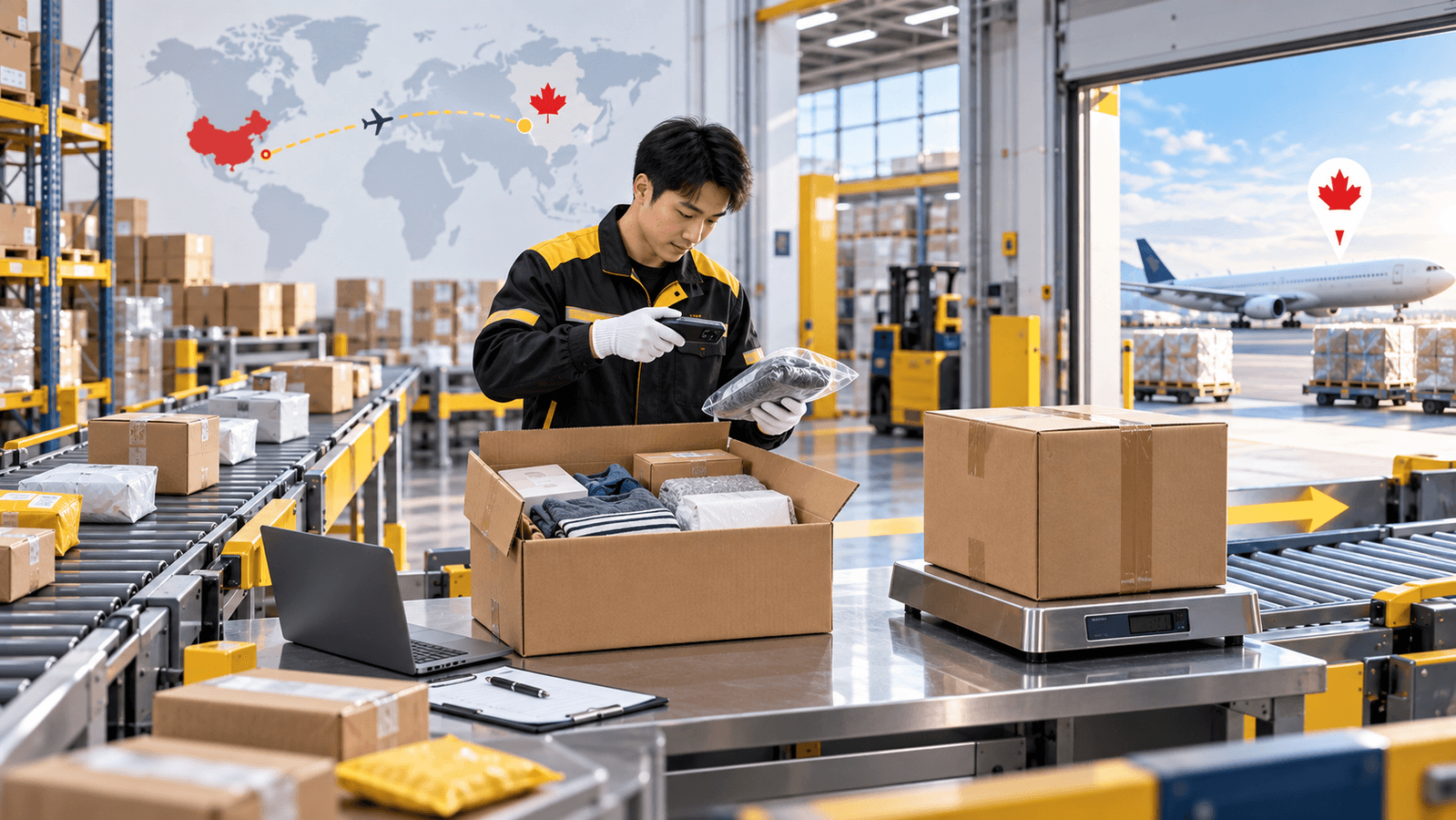
A forwarding shipment has three separate journeys. The seller sends each order to the warehouse in China. The warehouse receives, checks and combines the orders. The finished carton then travels internationally and enters Canadian delivery.
| Stage | What you do | What YANCHAO does | What can go wrong |
|---|---|---|---|
| Before purchase | Check the product and create an account | Provide a warehouse address and user ID | An item turns out to be restricted after it has already shipped |
| Domestic delivery | Use the exact address and submit each tracking number | Match arriving parcels to your account | Missing or hidden ID makes the parcel harder to identify |
| Warehouse | Review photos and choose which parcels to combine | Check in, photograph, consolidate and repack eligible goods | Unchecked liquids, food or batteries delay packing |
| International booking | Choose a route, packing options and insurance | Pack, measure and calculate the final chargeable weight | A bulky carton costs more than the seller weights suggested |
| Customs and delivery | Declare every item accurately and monitor tracking | Hand the parcel to the selected route and provide tracking | Vague descriptions or inadmissible goods can cause inspection or refusal |
1. Create your account before placing orders
Registration gives you a warehouse delivery address in China and a unique user ID. Keep the address exactly as shown in your account. The ID lets the warehouse connect an incoming domestic parcel with you, even when several customers buy from the same store.
Do this before shopping, not after the seller has printed the label. Save the recipient name, phone number, full Chinese address and ID in the address book of each marketplace you use.
The same warehouse account can receive eligible orders from Taobao, 1688, JD.com and other Chinese sellers. You do not need a separate international shipment for every store.
2. Check the items while they are still in the cart
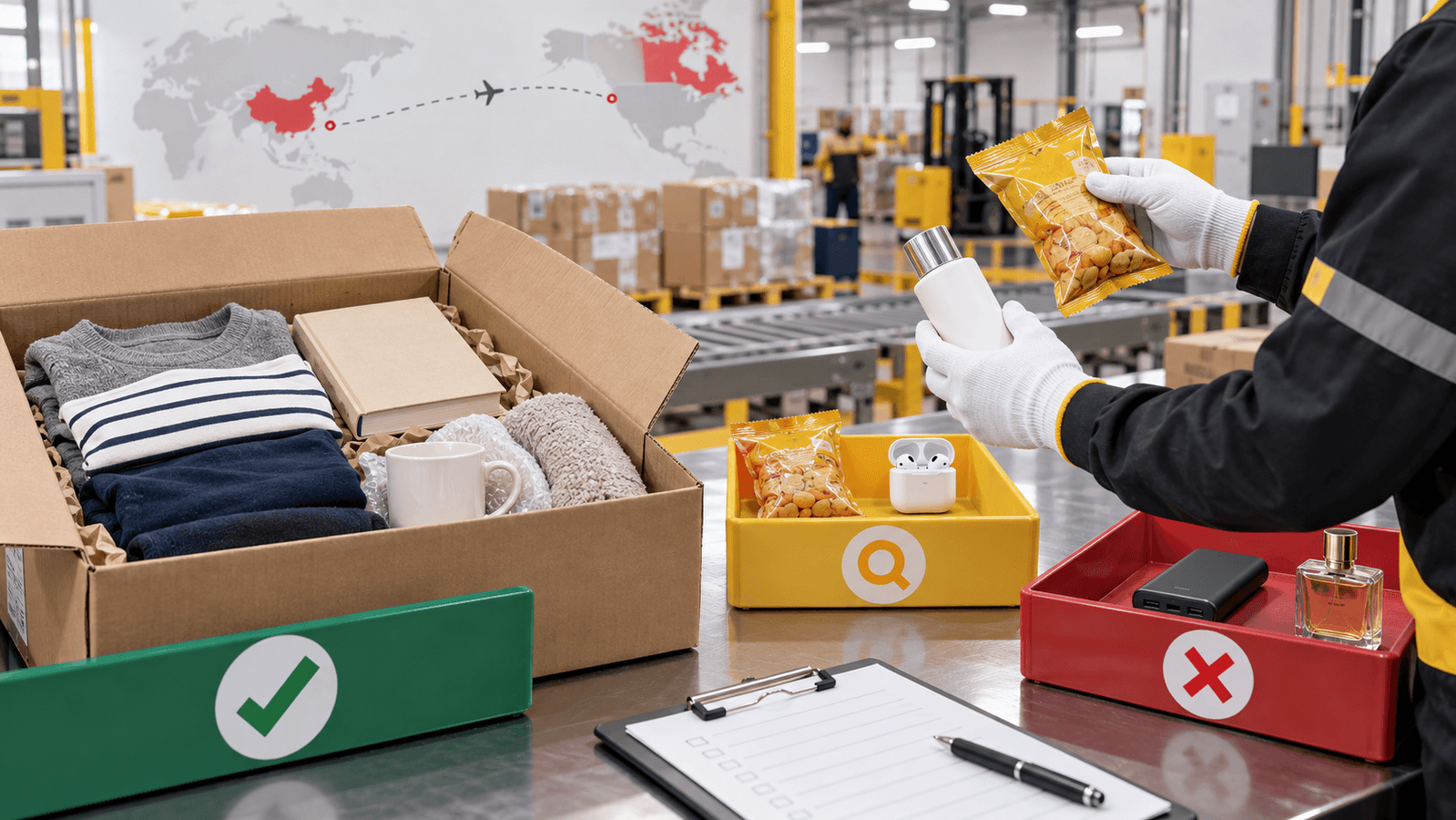
Clothing, books and ordinary household goods are usually simple. Food, cosmetics, medicines, powders, liquids, blades, wooden goods and electronics with an installed battery need a product-level review. Loose batteries, power banks and other prohibited goods must not be sent to the warehouse.
Send the product link and exact details before paying when the classification is unclear. For food or cosmetics, include readable ingredient labels and the amount in each package. For an electronic item, include the model, battery type, capacity and whether the battery is installed.
Route acceptance and Canadian admissibility are separate decisions. The Canada restricted-items guide explains this two-part check in detail. The Canadian Food Inspection Agency also says that its personal-use food rules apply to products bought online from abroad. Ingredients, origin, quantity and destination can all change the answer.
If the store listing is vague, ask the seller for a label photo. One clear photo now is easier than arranging a domestic return after warehouse arrival.
3. Use the warehouse address and ID on every order
Copy the address from your account into the seller's checkout page. Do not shorten it or remove the ID to make the field look cleaner. The domestic courier label is the main clue the warehouse has when the parcel arrives.
After the seller dispatches the order, add the domestic tracking number to your YANCHAO account. Enter one tracking number for each parcel. A large Taobao order may be split by the seller, so check the marketplace order page again if only part of the purchase appears in the warehouse.
The most common identification problem is simple. A seller hides the recipient details or leaves the user ID off the label. If the Chinese courier shows delivered but nothing appears in your account after the normal check-in period, send customer service the domestic tracking number so the warehouse can investigate.
4. Wait for check-in and review the arrival record
YANCHAO normally checks a signed domestic parcel into the account within 48 hours. Chinese public holidays and parcels with incomplete labels can take longer.
Open the arrival record instead of moving straight to international shipping. Check the parcel count, item photos and any notes. Confirm that the colour, size, quantity and visible condition match the order. A warehouse photograph cannot test every product function, but it can catch an obvious wrong item, missing unit or damaged outer package while a domestic return may still be possible.
Keep the shopping invoice or order screenshot. It helps with the customs declaration, an insurance request and any later question about value.
5. Let the orders accumulate, then decide what belongs together
YANCHAO currently provides 180 days of free storage. After that period, the published storage charge is ¥1 per item per day. The long window is useful when several sellers dispatch at different speeds, but there is little reason to leave a complete order sitting for months.
Combine items that can use the same route and tolerate the same packing method. Clothing, books and sturdy household goods often travel well together. A liquid cosmetic, fragile ornament and heavy metal tool may need a different arrangement even when a carrier accepts all three.
Consolidation is not a contest to fit everything into one box. Canadian air routes currently limit a parcel to 22 kg actual weight, while the sea route has its own 21 kg actual-weight limit and tighter carton dimensions. A large order may need two cartons. Splitting at the warehouse is much easier than having an oversized carton rejected after packing.
6. Choose the packing work before the warehouse closes the carton
Select any inspection, removal, reinforcement or compression work while submitting the shipment. YANCHAO's standard process includes photo inspection and removal of unnecessary domestic courier packaging. Vacuum compression may help with suitable clothing and bedding. Fragile items need added protection, although breakage risk cannot be removed completely.
Be specific. Write which retail boxes may be removed, which packaging must stay, and whether you need a particular item photographed again. Removing the branded retail box from a collectible or a return-sensitive electronic item may save space and still be the wrong decision for that purchase.
Warehouse repacking can reduce the carton, but it can also add material where protection is needed. The final measurement therefore matters more than the weights shown on the seller pages.
7. Understand chargeable weight before choosing a route
International routes compare actual weight with volumetric weight and charge the larger figure. A standard Canada route uses the following calculation unless the quotation states a different divisor.
length (cm) × width (cm) × height (cm) ÷ 6000 = volumetric weight (kg)
YANCHAO also lists a Canada non-volumetric sensitive-goods line with a divisor of 12000. That can help a large, light parcel, but only when the contents and destination qualify for the route.
The amount shown before packing is an estimate based on the incoming parcels and their original packaging. After consolidation, the warehouse weighs and measures the finished carton. The payable amount uses that final chargeable weight. If repacking reduces it, the difference is returned under the current adjustment process.
For a full calculation and a real Canada parcel example, use the China-to-Canada shipping cost guide.
8. Pick air or sea for the finished parcel
Route choice comes after the item and carton checks. Speed alone cannot decide it. The cargo type, chargeable weight, carton dimensions and Canadian postal code have to fit the same service.
The table below is a YANCHAO route snapshot checked on 18 September 2026. Times are estimates rather than guaranteed delivery dates, and current availability must be checked in the live calculator.
| Current Canada route | Usually suits | Reference transit time | Important condition |
|---|---|---|---|
| General-goods air line | Smaller parcels containing ordinary goods | 8–15 days | General goods only; volumetric divisor 6000 |
| Special-goods air line | Eligible food, cosmetics or other reviewed sensitive goods | 8–12 days | Product approval is required; volumetric divisor 6000 |
| Sensitive non-volumetric air line | Eligible bulky, light and sensitive goods | 8–12 days | Product approval is required; volumetric divisor 12000 |
| Canada sea line | Larger eligible shipments | 40–55 days | Starts at 13 kg; single-carton size and weight limits still apply |
Air usually makes sense for a smaller parcel, a fixed arrival date or goods that would not save much by sea. Sea becomes worth checking when the eligible shipment clears the 13 kg minimum and the longer wait is acceptable. The air-versus-sea Canada guide provides the fuller decision table.
9. Read the route terms, including tax handling and insurance
The current YANCHAO Canada routes listed above are described as tax-inclusive, door-to-door services. Treat that statement as a term of the selected quotation, not permission to ignore customs rules. Confirm it again on the checkout page because route terms and availability can change.
CBSA reviews international mail and courier shipments. It decides whether goods may enter Canada and whether duty or tax applies. The amount can depend on the goods, value, origin, whether the parcel qualifies as a genuine gift, and the province of delivery. Accurate invoices and item descriptions still matter when a forwarding route handles the clearance arrangement.
Review insurance before paying. Basic cover has limits and exclusions. Paid declared-value insurance requires a qualifying purchase record and must be arranged before dispatch. Fragile-item damage, an incorrect delivery address and theft after a successful delivery scan are among the situations that may fall outside standard protection. Expensive goods deserve a written insurance answer, not an assumption based on a badge beside the route name.
10. Declare the contents item by item
Write a plain, accurate product name, quantity and value for every item. A declaration such as “daily necessities” says very little when the box contains two shirts, a face cream and a pair of earbuds.
A better declaration separates them.
| Weak description | Useful description |
|---|---|
| Clothes | 2 cotton T-shirts and 1 polyester jacket |
| Skincare | 2 facial moisturisers, 50 ml each |
| Electronics | 1 pair of wireless earbuds with installed lithium-ion batteries |
| Snacks | 4 sealed packets of biscuits, 300 g each |
Use the real transaction value and keep the store receipts. Do not mark an online purchase as a gift. CBSA's gift treatment applies when a friend or relative personally sends a genuine gift and includes a card or other notice. A business shipment or purchase does not become a gift because the declaration box was ticked.
11. Pay, follow the tracking and keep the records
Check the final carton data, route, address, declaration and insurance selection before payment. After the shipment is accepted, the account provides the international tracking record. Some routes show several milestones rather than a scan every day, especially while freight is moving between countries or waiting for clearance.
Keep these records until delivery is complete.
- the Chinese store orders and payment receipts;
- domestic tracking numbers and warehouse photos;
- the final packing measurement and shipping invoice;
- the customs declaration and insurance evidence;
- the international tracking number and delivery record.
If tracking stops moving, use the international number when contacting support. If Canadian authorities or the delivery carrier asks for an invoice or product details, reply with the same accurate information used for the declaration.
A pre-payment check that takes two minutes
Pause at the payment screen and read the order once from top to bottom.
- Every item appears by name, quantity and honest value.
- Sensitive goods have written route approval.
- The Canadian name, street, unit number, city, province, postal code and phone number are complete.
- The route accepts the goods, chargeable weight and carton dimensions.
- Tax handling and possible destination charges are clear.
- Insurance matches the value and you have the required purchase evidence.
- The delivery window works for travel, residence moves and building access.
Two minutes here can prevent a week of messages after dispatch.
Frequently asked questions
Can I combine Taobao and 1688 orders for one shipment to Canada?
Yes. Eligible parcels from different Chinese stores can enter the same YANCHAO warehouse account and be consolidated later. Use the exact warehouse address and your unique ID on every order, then submit each domestic tracking number separately.
How long can my parcels stay in the YANCHAO warehouse?
The current policy provides 180 days of free storage. After the free period, the published charge is ¥1 per item per day. Check the current account terms before leaving goods for a long period because storage policies can change.
How soon will a domestic parcel appear in my account?
YANCHAO normally completes warehouse check-in within 48 hours after the Chinese courier marks the parcel as delivered. Public holidays, a missing user ID or hidden recipient information can delay identification. Keep the domestic tracking number so the warehouse can trace it.
When is the final shipping cost confirmed?
The pre-packing amount is an estimate. The warehouse consolidates and repacks the selected parcels, then measures the finished carton's actual and volumetric weight. The route charges the larger applicable figure, and the account adjusts the difference under the current billing process.
Will I have to pay duty or tax in Canada?
CBSA determines admissibility and any duty or tax. Current YANCHAO Canada quotations may include tax handling on specified door-to-door routes, but the selected route terms, accurate declaration and product eligibility still control the shipment. Confirm the live quotation before payment.
Start with the shopping cart, not the shipping button
A clean forwarding order is mostly preparation. Use the correct warehouse ID, check uncertain goods before purchase, keep the invoices, wait for the arrival photos, and choose the route using the final carton rather than a pile of seller estimates.
YANCHAO can receive, photograph, consolidate and repack eligible personal purchases in its Huizhou warehouse. If you are still comparing providers, the Canada package-forwarding company guide explains the service terms worth checking. Current operational questions are also covered in the YANCHAO Help Center.
Sources and review date
- YANCHAO warehouse, packing, storage, cargo-classification, Canada route and insurance rules, reviewed 18 September 2026.
- CBSA, Importing by mail or courier, reviewed 18 September 2026.
- CBSA, Ship and report goods, reviewed 18 September 2026.
- CFIA, Bringing food into Canada for personal use, reviewed 18 September 2026.
Last reviewed by the YANCHAO Content Team on 18 September 2026. Route availability, prices and government requirements can change. Recheck the live quotation and the exact goods before dispatch.

About the author
YANCHAO Team
Cross-Border Shipping Experts
This article is brought to you by the YANCHAO team - the people behind our self-developed warehouse platform and 5,000 m2 Huizhou facility. We help over 5 million international students and overseas shoppers ship safely and affordably from China to 100+ countries.
More about YANCHAO