
- By YANCHAO
- 2026-10-20
- Logistics News
Alibaba Truck Dashboard: Calculate US Landed Cost

The correct comparison is not $130 versus the price shown by a US seller. It is the total cost of obtaining a dashboard that fits the exact truck, survives international transport, clears import requirements, and reaches the intended delivery point. A cheap but incompatible dashboard has no freight advantage. A part that cracks because its unsupported edge was compressed is not a successful delivery.
On 19 October 2026, a first-time buyer asked in a public Reddit post whether a truck dashboard offered for about $130 on Alibaba would remain worthwhile after shipment to the United States. The post establishes a real buyer decision. It does not disclose the truck year, part number, material, carton size, gross weight, US ZIP code, or seller's shipping scope. It therefore cannot support a current freight number or a claimed saving.
Pass the fitment gate before requesting freight
The first worksheet should describe the part, not the route. Record the truck make, model, model year, left- or right-hand-drive configuration, dashboard variant, airbag openings, instrument and vent positions, color, surface material, mounting points, and part number. Ask the supplier for a dimensioned drawing and photographs of the actual version. Put the accepted specification into the order or pro forma invoice rather than leaving it in an informal chat.
Clarify whether the listing is a bare molded cover, a trim assembly, or a unit containing wiring, lamps, sensors, switches, or airbag-related components. US Customs and Border Protection notes that requirements for vehicle parts depend on the particular part. A decorative shell and a safety-related assembly should not be treated as the same import merely because both are called a dashboard.
Fitment changes the economics because an oversized international return may be impractical. If the seller sends the wrong aperture layout, the buyer may face four unattractive choices: pay to return it, accept a partial refund, resell it, or discard it. The expected cost of that failure belongs in the landed-cost decision. A domestic seller's higher price may include easier fitment support, faster replacement, and a workable return address.
Before payment, request a tolerance statement for the key mounting dimensions and an agreed remedy for a nonconforming part. A generic promise that a part “fits” is weaker than a record that names the vehicle configuration and measurable features.
Build an eight-input landed-cost card
Use one card for the Alibaba option and one for the US option. Keep the scope identical.
1. Transaction value. Record the amount actually paid for the goods. CBP's guidance on the commercial invoice says the value should be the price the US buyer paid, not the amount for which the goods may later be sold in the United States. Do not ask a supplier to lower the declared value to make the comparison look better.
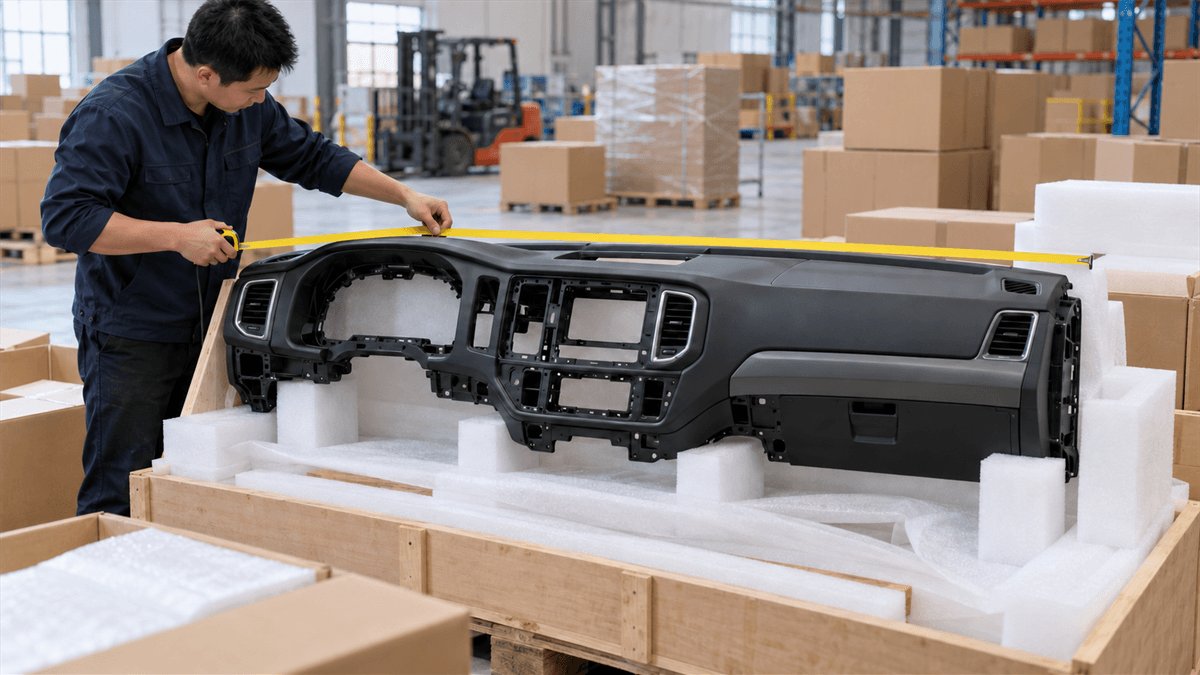
2. Original packed dimensions and gross weight. Obtain length, width, height, and gross weight for the shipping package. Product weight alone is not enough. Ask whether the dimensions include foam, corner protectors, a rigid shell, crate, or pallet.
3. Reinforced dimensions and weight. A dashboard may need added support around long edges, corners, vents, and mounting tabs. Reinforcement can reduce damage risk while increasing chargeable weight. Request measurements and photographs after the final packing method is selected.
4. China-side delivery and warehouse work. Confirm whether $130 includes delivery to the nominated China warehouse. Add receipt, inspection, photographs, repacking, crating, and any oversize handling actually required. Do not add optional services that do not solve a defined risk.
5. International chargeable weight. UPS explains that dimensional weight reflects the space a package occupies relative to actual weight and may affect the shipping charge for a large, light package. The applicable divisor, rounding, size limit, surcharge, and service availability vary. Use the live order page or written quotation for the final packed carton; do not import a formula from a different service or year.
6. Import duty, entry, and other charges. Classification depends on the actual component, material, and use. CBP also explains that duties and user fees can depend on the commodity, value, entry type, and mode of transport. A low product price does not prove that every import or processing cost is zero.
7. US final-mile scope. Ask whether the quote includes residential delivery, remote-area service, appointment, liftgate, inside delivery, or collection from a terminal. “Door delivery” should identify the physical handoff. An oversize carton that stops at a freight terminal is not comparable with a local part delivered to a workshop.
8. Failure and after-sales cost. Add inspection, missing-hardware replacement, repair, return, re-shipment, disposal, and vehicle downtime where relevant. If insurance is offered, obtain the insured basis, exclusions, deductible, packing requirements, evidence deadline, and maximum liability. Insurance is a claim process, not a guarantee that every loss is paid.
The decision line is simple: compare the completed cross-border total with the local delivered price after assigning a realistic value to fitment support and returns. If one input is missing, mark it as unresolved instead of entering zero.
Use the China warehouse as an evidence point
For a large interior part, a warehouse can do more than forward a sealed carton. At receipt, it can record the outer package, seller tracking number, labels, visible crushing, and item count. If the buyer authorizes opening, the inspection instruction should name the required views: part number, front and back, mounting tabs, connectors, vents, airbag aperture, long edges, and corners.
The evidence should connect the marketplace order to the domestic parcel and warehouse receipt. Photographs without a parcel identifier or date are hard to use in a dispute. Measurements should show the final carton, not a supplier estimate copied from a product page.
Packing is a tradeoff. Removing every original support may reduce size but expose the part to bending. Adding a heavy crate may improve compression resistance but make the shipment much more expensive. Ask for two packing proposals where practical: the smallest arrangement that still protects the structure, and a more rigid option. Price both against the same destination and service scope.
YANCHAO can document China-side steps it actually performs, such as receipt, instructed photographs, consolidation or repacking records, and final weight and dimensions. Those records help a buyer request a proper quotation and identify where visible damage first appeared. They cannot prove vehicle compatibility, choose the correct customs classification for the importer, guarantee clearance, or provide US warranty coverage.
The live freight capability required for a current route quotation was not available for this article. No present price, fixed transit time, or claim that a particular service accepts the carton is published. A quote must be requested after the final packaging data and ZIP code are known.
Decide from three possible outcomes
Fitment is verified and the packed carton remains within an ordinary quoted service. Obtain a written quotation that identifies chargeable weight, included handling, customs scope, destination charges, and final delivery point. Compare it with the local delivered price and return terms. If the difference remains meaningful, a one-unit trial can be reasonable.
The product is cheap but the carton triggers oversize economics. Ask whether safe dimensional reduction is possible and whether removable, non-critical components can be packed separately without increasing damage or losing parts. Compare an accepted large-parcel service with a lawful freight option. A low ocean line-haul number is not a door price; origin handling, import, destination, and final-mile charges must remain in the card.
Fitment, material, or seller remedy remains unclear. Stop before payment. Request the part number, drawings, component list, packaging method, and written responsibility for a mismatch. Freight should not be used to test a product description that the seller will not make specific.
The buyer should also check the installer. Some shops may decline customer-supplied parts or offer no warranty on labor if the part is defective. Confirm whether the installer wants the vehicle identification details, can inspect the part before installation, and will identify missing clips or brackets promptly. This turns “cheaper online” into a complete operational comparison.
A quotation request that produces comparable answers
Send the forwarder one structured message: “The product is a truck dashboard for this make, model, year, and configuration. It is a bare shell or contains the following components. Final reinforced carton dimensions are L × W × H, gross weight is X, material is Y, declared transaction value is Z, and destination is this ZIP code. Please identify chargeable weight, packing or oversize charges, customs scope, destination charges, delivery point, excluded services, insurance terms, and which amounts remain provisional.”
If the response contains only a total, ask for the scope behind it. If dimensions are still estimates, keep the amount provisional. If the service cannot state how an oversized carton is handed over in the United States, it is not yet comparable with a local purchase.
Before authorising dispatch, conduct a final evidence review on the same day as payment. Match the seller order, part number, inspection images, packing images, measured dimensions, gross weight, declared description, insured value, service name, consignee, and ZIP code. Save the quotation version and identify its expiry or re-rating condition. Ask which party will provide the first international acceptance record and whether a separate US last-mile number will be issued. This review does not eliminate transport or customs risk, but it prevents a buyer from paying against a stale estimate or a quotation for a different carton.
FAQ: Practical Follow-up Questions
Can a forwarder quote from the Alibaba product link alone?
Only a rough planning range may be possible. A decision-grade quote needs final reinforced dimensions, gross weight, material and component details, transaction value, and destination ZIP code. The applicable service must then confirm its current dimensional-weight and oversize rules.
Is a wooden crate always the safest choice?
No. A crate can improve resistance to compression and puncture, but it also adds size and weight and may require special handling. Select protection from the dashboard's structure, the carrier's acceptance rules, and the insurance packing conditions. Compare the measured carton after each proposed method.
What should happen if the warehouse finds the wrong dashboard?
Pause international dispatch. Compare the order specification, part number, drawing, and warehouse photographs. Resolve return, replacement, or refund options while the item is still in China. Sending a known mismatch across the border usually reduces the buyer's practical options.

About the author
YANCHAO Team
Cross-Border Shipping Experts
This article is brought to you by the YANCHAO team - the people behind our self-developed warehouse platform and 5,000 m2 Huizhou facility. We help over 5 million international students and overseas shoppers ship safely and affordably from China to 100+ countries.
More about YANCHAO