
- By YANCHAO
- 2026-10-15
- Logistics News
Alibaba Diving Gear Mold: Accept a Partial Refund?

Do not power on, breathe through, clean, or dismantle mold-affected diving air equipment merely to see whether it works. The visible mold may be limited to packaging, but a buyer cannot establish from appearance alone whether moisture or contamination entered an air path, hose, filter, housing, or other safety-relevant component. A partial refund answers a money question; it does not answer a breathing-safety question.
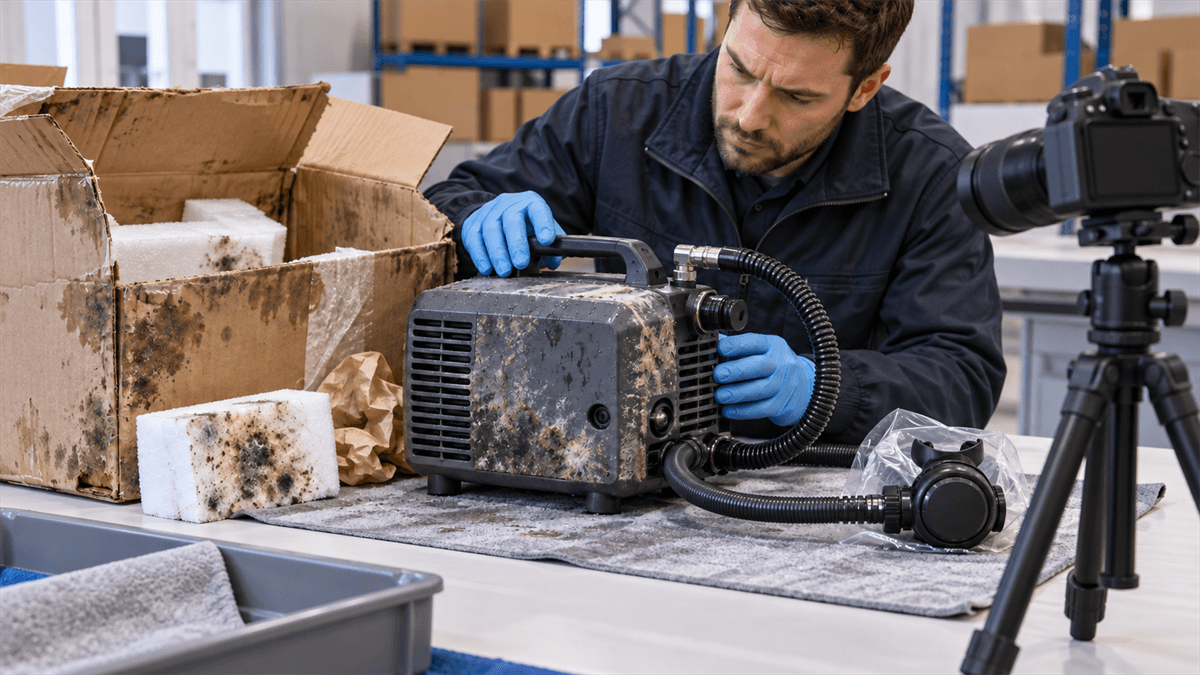
On 14 October 2026, a buyer stated in a public Reddit post that an Alibaba diving air device costing about US$700 arrived late with mold visible in the box and on the equipment. The buyer said that offers of US$150 and then US$200 were discussed and that rejecting an offer might close the case. This is evidence of one person's reported problem, not proof of the cause, product condition, platform liability, or final outcome. Those points require transaction records, inspection evidence, and the rules applied to the actual order.
First decision: is the equipment usable, repairable, or unsuitable?
Treat the device as safety-relevant until a competent person says otherwise. Isolate it in a dry place without altering the evidence. Do not spray chemicals into openings, run the unit, replace filters, or discard packaging. Cleaning may remove visible mold while leaving the technical question unresolved, and disassembly may make it harder to show the received condition.
Ask the manufacturer or an authorized or suitably qualified diving-equipment technician what inspection is required for that exact model. The request should identify where mold was seen, whether any seal was broken, whether the unit was powered, and how it was stored after delivery. Ask for a written conclusion that distinguishes external packaging contamination from possible contamination of safety-relevant components. If the professional cannot clear the unit without internal inspection, that uncertainty belongs in the dispute.
The buyer should not let the seller reduce the issue to appearance before the safety question is answered. A useful message is: “This product supplies breathing air. It has not been used. Mold was visible at delivery in the locations shown. Please confirm the manufacturer-approved inspection, return, or replacement procedure and who will pay the associated cost.” This does not claim a technical result that has not been established.
There are three practical remedies. A return and full refund restores the parties as far as possible but requires clear shipping instructions and evidence of handover. A replacement may work if the buyer still trusts the product and the replacement can be independently documented. A partial refund is sensible only when the buyer knowingly keeps a product whose safe and intended use has been established, or when the payment compensates for a non-safety defect under clear terms. It should not be used as a substitute for an unresolved breathing-risk assessment.
Build a chain of evidence, not a folder of random photographs
The evidence should show what arrived, when it arrived, and how the condition was discovered. Preserve photographs of all six sides of the unopened shipping carton, the label, seals, dents, water marks, and any odor or visible residue that can be described without speculation. Keep the original files with timestamps. A continuous opening video is particularly useful when available, but its absence does not make every other form of evidence worthless.
Photograph the position of each item before moving it, the inner packaging, desiccant or protective material, the equipment from multiple angles, serial numbers, and both close and wide views of each affected area. A close-up proves little if it cannot be located on the product. Keep the carton, inserts, bags, manuals, and accessories until the dispute and any inspection are complete.
Then connect the images to transaction records: the listing and specifications, order confirmation, payment record, seller messages, dispatch date, carrier events, delivery confirmation, and the time the condition was reported. Request pre-shipment photographs, packing records, serial-number records, and any outgoing inspection evidence from the seller. If a forwarding warehouse handled the item, request inbound photographs, weight, repacking records, and dispatch handover evidence.
YANCHAO can provide records for China-side steps it actually performs, such as warehouse receipt, inspection photographs, packing, weight, and dispatch. Those records can help establish custody and condition at specific points. They cannot certify that a breathing device is safe, determine why mold developed, or decide an Alibaba or payment-provider dispute.
Organize the evidence as a timeline: order, seller dispatch, warehouse or carrier handover, delivery, opening, first notice, seller response, platform filing, and technical inspection. Label each item with what it proves. Keep original files and submission receipts. Avoid editing images in a way that removes metadata or context, and never reconstruct an opening event that was not recorded.
Ask what the partial refund legally and procedurally does
Before accepting, ask Alibaba through the official dispute channel whether the amount is a final settlement, whether the case closes immediately, whether return or replacement rights remain, and whether later technical evidence can be added. Ask the payment provider separately whether a merchant partial refund changes an open claim, the amount in dispute, payment scheduling, or documentation deadlines. The answer must be specific to the transaction and account.
Do not rely on a seller's private promise that more money will follow after the platform case is closed. A safe settlement record identifies the amount, currency, payment method, deadline, product disposition, shipping responsibility, and whether any further claim is waived. If those points are absent, the buyer does not yet know what is being accepted.
Keep the two channels consistent. If the buyer tells Alibaba that the product is unusable but tells the payment provider that the problem is only cosmetic, the inconsistency may weaken the evidence. Disclose the partial offer accurately, state whether it was accepted, and explain that equipment safety remains pending if that is true.
Deadlines need their own checklist. Record the platform evidence deadline, offer-expiry time, return-label validity, card or payment-provider dispute deadline, and any date for submitting a technical report. When a deadline arrives before the inspection, submit the evidence already available and state what report is pending. Save confirmation that the submission was received.
A decision card for the next action
Only the outer carton shows mold and the device remains sealed: document everything and ask the manufacturer what packaging or storage condition requires inspection. Do not declare the device safe without an applicable technical basis.
Mold is visible on the device, hose, inlet, filter area, or other relevant component: stop use and seek a return, replacement, or qualified inspection route. A small payment does not resolve the safety question.
The partial-refund terms are unclear: do not click accept. Ask whether the payment closes the case, changes other remedies, or prevents later evidence.
A dispute deadline is close: file the current evidence on time, identify missing documents, and preserve the receipt. Waiting for perfect evidence can eliminate the channel entirely.
The seller asks for an off-platform arrangement: keep the official dispute open until the terms, funds, and consequences are verifiable. Do not close a protected process solely on a promise.
A technician says the product cannot be cleared without destructive inspection: submit that statement and ask who authorizes and pays for the work. Do not commission irreversible work without documenting its effect on return eligibility.
Prevention begins before shipment. For a high-value device, the purchase instructions should specify model and serial verification, dry-condition inspection, packaging and moisture protection, continuous packing images, carton weight, and an exception hold. “Visual inspection” should be defined: which surfaces, openings, accessories, seals, and labels must be shown. Functional or breathing-safety testing is a separate service and should never be implied by ordinary warehouse photography.
If a warehouse observes moisture, odor, staining, or mold, it should pause dispatch and present the buyer with evidence and options. The buyer can then request seller return, qualified inspection, replacement, or repacking after the underlying concern is addressed. Shipping a visibly affected safety product onward may make the final evidence chain harder, not easier.
FAQ: Practical Follow-up Questions
Can I clean the mold and test the equipment once?
That is not a sound first step for equipment that supplies breathing air. Cleaning can change the evidence and cannot prove that internal paths are unaffected. Preserve the received condition and obtain model-specific guidance from the manufacturer, an authorized service center, or a suitably qualified diving-equipment technician.
Does accepting an Alibaba partial refund cancel a payment-provider claim?
There is no universal answer. Ask both Alibaba and the payment provider for written, transaction-specific confirmation. Clarify whether the payment is final settlement, whether the platform case closes, what amount remains disputed, and whether later inspection evidence can still be submitted.
What if I did not record a complete unboxing video?
Submit the evidence that exists: carton and label photographs, delivery records, original images of affected areas, seller messages, prompt notice, and any professional inspection statement. Explain the missing video honestly. An incomplete record may affect evaluation, but fabricated or reconstructed evidence is far more damaging.

About the author
YANCHAO Team
Cross-Border Shipping Experts
This article is brought to you by the YANCHAO team - the people behind our self-developed warehouse platform and 5,000 m2 Huizhou facility. We help over 5 million international students and overseas shoppers ship safely and affordably from China to 100+ countries.
More about YANCHAO