
- By YANCHAO
- 2026-10-20
- Logistics News
Alibaba Tableware for US Restaurants: True Cost

The important denominator is not 10,000 pieces ordered. It is the number of conforming pieces that can be used for the intended food, temperature, handling, and service environment and can reach the correct restaurant before they are needed. A purchase is not economical when restaurants must store a year's supply of the wrong sauce cup, when custom printing fails, or when a material document does not cover the actual product.
On 19 October 2026, a US restaurant operator asked in a public Reddit post whether five restaurants should buy roughly 10,000 pieces of silverware, sauce cups, custom takeaway packaging, and related supplies through Alibaba. The post establishes a realistic purchasing decision. It does not disclose the materials, SKU mix, annual consumption, carton dimensions, destination warehouse, or supplier documents. It cannot support a current freight total or a guaranteed saving.
Define food-contact use before negotiating MOQ
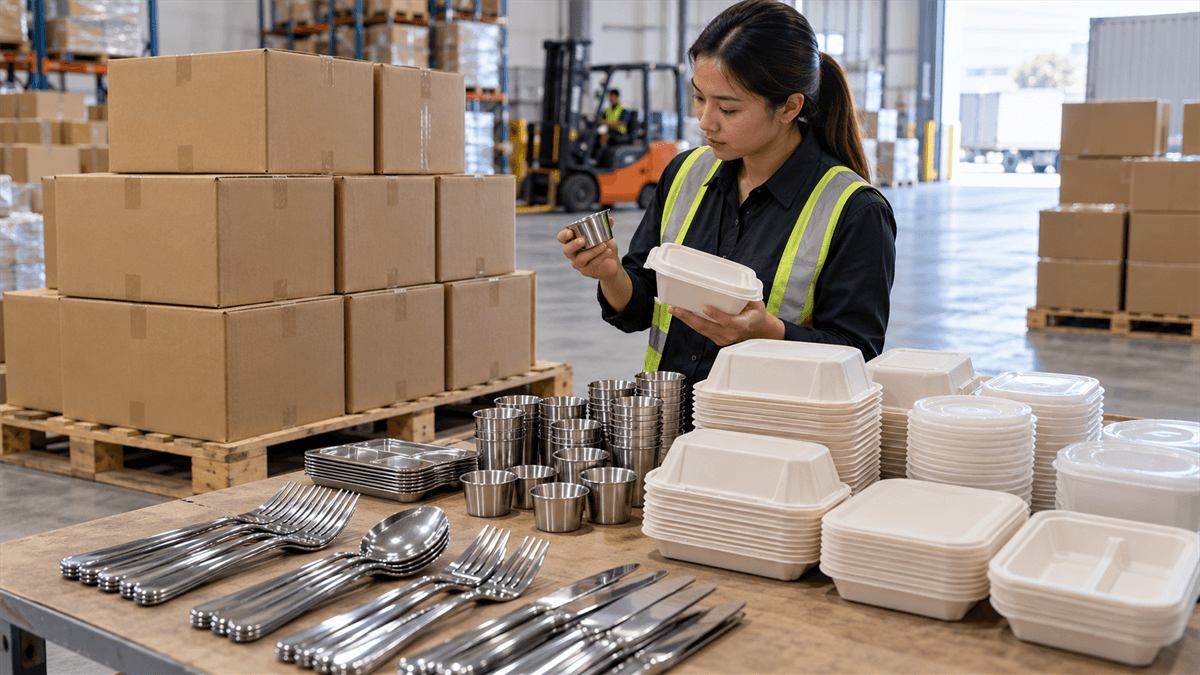
“Tableware” is not one regulatory or technical category. Stainless-steel utensils, melamine dishes, plastic sauce cups, coated paper containers, printed takeaway boxes, lids, and decorative service items use different materials and may face different conditions of use. Contact with hot soup, acidic sauce, oil, dry food, refrigeration, microwave heating, repeated washing, and single-use service are not interchangeable.
The US Food and Drug Administration explains that the regulatory status of a food-contact material depends on the substances composing the article and their intended use. FDA's conditions-of-use references distinguish food types and temperature or storage conditions. A supplier statement that a product is “food grade” is therefore only a starting claim. It does not identify the material, authorization basis, manufacturer, or permitted use.
Create one specification record for every SKU. Include material identity and grade; coating, ink, adhesive, and colorant where applicable; manufacturer; dimensions and capacity; intended food type; maximum temperature and contact time; single-use or repeated-use status; dishwasher, microwave, freezer, or hot-fill conditions; and the evidence supporting that use.
Review every report against the actual item. Match the model or sample description, material, manufacturer, test scope, date, standard, and use conditions. A report for a similar cup from a different factory does not automatically cover the ordered cup. FDA also notes that some Food Contact Notifications are manufacturer-specific, making supply-chain identity important rather than administrative detail.
For mixed restaurant supplies, a single document folder should not be labelled “FDA certificate” and assumed to solve all SKUs. The buyer or importer should obtain qualified compliance advice for the actual products and intended uses. A forwarder can organise documents but does not make the regulatory determination.
Move from sample to trial batch before annual volume
The first stage is document review and samples. Obtain the material declaration, product specification, existing compliance evidence, packaging method, custom-print artwork, and actual samples. Test the samples in restaurant conditions: hot, cold, acidic, oily, refrigerated, stacked, carried, washed, opened, closed, and handled by staff. Record odour, staining, leakage, warping, lid fit, sharp edges, finish, dimensions, and breakage.
The second stage is a trial batch large enough to operate across the five restaurants. A sample may be hand-selected; a trial batch tests production and packing consistency. Count received units, compare dimensions, inspect print variation, record damaged cartons, note employee handling issues, and capture customer complaints that relate to function. Agree in advance on an inspection method and acceptable tolerance rather than arguing from photographs after production.
The third stage is measured consumption. Each restaurant should report use by SKU over a representative period. Separate dine-in, takeaway, catering, promotions, and seasonal peaks. Do not divide total annual volume equally among five locations unless their menus and traffic are genuinely similar. A sauce cup can move quickly at one location and become dead stock at another.
The fourth stage is production and replenishment design. Compare one production run with one shipment, one production run released in batches, repeated smaller orders, or a mixed model in which stable high-volume SKUs are imported while uncertain items remain locally sourced. State who holds inventory at every point and who bears loss, ageing, and change risk.
Calculate cost per usable unit at the restaurant
Build the numerator from all costs required to make the item available for use: samples; document or testing review; mould, plate, or artwork charges; goods; custom printing; export packaging; China domestic transport; inspection and warehouse work; pallets or reinforcement; international freight; customs entry and import charges; US unloading; warehousing; pick and dispatch; transport to five restaurants; damage; rejected units; disposal; finance cost; and emergency local purchases during a shortage.
Then correct the denominator. Ten thousand ordered units may not equal 10,000 usable units. Remove verified defects, transit damage, print errors, shortages, and obsolete stock. Divide the full cost by accepted usable units, then add location-level distribution where it has not already been included.
Compare that number with the US option on the same scope. A domestic price may include shorter replenishment, lower minimums, easier returns, less storage, and faster specification changes. Those services have economic value even if they do not appear as a line called freight.
US Customs and Border Protection states that commercial goods entering US commerce may require consumption entry procedures and that importers are responsible for compliance with requirements administered by other agencies such as FDA. Tariff classification, duty, entry form, and fees depend on the actual commodity, material, value, and mode. Do not assign one tariff result to all “tableware” or enter zero because the unit price is small.
Current carton counts, dimensions, gross weights, materials, origin location, US warehouse ZIP code, and shipment schedule were not available. The live freight capability required for route verification was also unavailable. This article therefore publishes no ocean rate, fixed transit time, duty percentage, or claim that 10,000 units are necessarily cheaper. The freight request must separate origin, line-haul, customs scope, destination, storage, and restaurant distribution.
Make inventory visible before it becomes a burden
The first inventory question is where the goods will physically sit. Restaurant back rooms are often poor long-term warehouses. Cartons can block work areas, absorb moisture, collect grease, become difficult to count, or be opened without recording usage. A US warehouse adds charges but may improve inventory control and staged distribution. Quote receiving, pallet or bin storage, monthly minimums, pick fees, outbound packing, and local delivery together.
The second question is who owns the inventory. Five restaurants sharing a purchase should document payment shares, SKU allocations, title to stock, responsibility for damage and shrinkage, authority to reorder, and a mechanism for a location that reduces consumption or leaves the group. Without this agreement, a purchasing discount can become a dispute over unwanted stock.
The third question is when to reorder. Calculate days of cover from usable on-hand inventory and recent consumption by SKU. Compare that with a conservative, evidence-based replenishment window covering supplier production, China transport, international movement, customs, US receiving, and distribution. Since no live route was verified here, use the actual supplier and logistics plan rather than a generic number from another shipment.
Set decision thresholds before placing the large order. For example, require approved material evidence, an accepted reference sample, a successful trial batch, a maximum defect level, a minimum remaining shelf or service life where relevant, and enough cost advantage to absorb a defined quality or demand variance. The exact thresholds belong to the restaurant group, but writing them down prevents the factory unit price from dominating every later decision.
Divide responsibilities across the purchasing chain
The supplier should provide accurate specifications, manufacturer identity, production and packing records, and agreed remedies. The restaurant group or importer should define intended use, review compliance, approve samples, measure demand, and decide inventory exposure. The customs broker or qualified adviser should address classification and entry questions. The warehouse should record receipt, count, condition, lot or batch information where available, and outbound allocation.
YANCHAO can help consolidate samples and multiple SKUs in China, record inbound batches, perform instructed visual or count checks, document carton measurements, and organise quotations for staged shipping. It cannot certify a food-contact article, guarantee that a supplier preserves a formulation over time, or assume the US importer's regulatory responsibilities. Those boundaries should appear in the procurement plan before production.
For custom printing, control the approved artwork and production reference. Confirm color, position, size, abrasion or wash performance relevant to the use, carton marking, and acceptable variation. A logo error repeated across 10,000 units is an inventory loss, not a minor cosmetic issue.
When the 10,000-unit order becomes defensible
Proceed only when four conditions are satisfied. Each SKU has a specific intended use and evidence package. Samples and the trial batch are consistent. Consumption and inventory responsibility are measured across the five restaurants. The complete cost per usable unit remains attractive after freight, import, storage, distribution, defects, and uncertainty.
If one condition fails, reduce quantity, remove uncertain SKUs, or preserve a local source. Combining silverware, sauce cups, and takeaway packaging may simplify supplier communication but increases the number of materials, cartons, inspection methods, and replenishment patterns. The cheapest answer may be a hybrid plan rather than one container or one purchase order.
Before production release, hold a sign-off with the restaurant operator, compliance reviewer, supplier, and logistics parties. Freeze the SKU list, materials, reference samples, artwork, carton packing, inspection instruction, delivery allocation, document set, and change-control rule. A supplier substitution after approval should trigger review, not silent acceptance.
FAQ: Practical Follow-up Questions
Is a supplier's FDA test report enough to import the products?
Not by itself. Match the report to the actual product, material, manufacturer, test scope, intended use, and date. The importer remains responsible for the applicable compliance and entry requirements.
Will combining five restaurants always lower freight cost?
No. Larger volume may improve one transport component while increasing pallets, storage, handling, location distribution, finance cost, and obsolete-stock risk. Compare cost per usable unit delivered to each restaurant.
When should custom logos be approved?
Approve artwork and performance during samples and the trial batch, then lock the signed reference and permitted variation before mass production. Also confirm carton marks so stock can be allocated correctly.

About the author
YANCHAO Team
Cross-Border Shipping Experts
This article is brought to you by the YANCHAO team - the people behind our self-developed warehouse platform and 5,000 m2 Huizhou facility. We help over 5 million international students and overseas shoppers ship safely and affordably from China to 100+ countries.
More about YANCHAO