
- By YANCHAO
- 2026-10-15
- Logistics News
How US Buyers Can Vet Personal Shoppers in Asia

Start with evidence of execution, not popularity. A personal shopper may have an active social account and friendly reviews yet still lack a reliable process for buying a limited bag, documenting authenticity signals, consolidating character merchandise, or shipping to the United States. The safest sequence is to verify the shopper's operating location and purchasing scope, compare a fully itemized quote, and run a small order through purchase, receipt, inspection, packing, and international tracking.
On 14 October 2026, a US-based user posted publicly that they were seeking a personal shopper in China, Japan, or South Korea for local-brand bags, regional releases, and Crayon Shin-chan plush toys, figures, and accessories. The user asked respondents to state their location, fees, shipping methods, and verifiable reviews. The post proves that this purchasing need exists. It does not verify any respondent, guarantee authenticity, or establish that one shopper can lawfully and reliably operate across all three countries.
Verify operating ability without collecting unnecessary identity data
The first question is where the shopper actually operates. Ask for the country and general purchasing area, the online platforms and physical stores they can use, payment currencies, order limits, and whether they buy directly or subcontract. A person in China should not be assumed to have direct purchasing and return capability in Japan or South Korea. If partners are involved, ask who receives the money, who buys, who holds the goods, and who is responsible when something goes wrong.
Do not demand sensitive identity documents that are unnecessary for the transaction. Better verification comes from consistent operational evidence: a dated, item-specific quote; anonymized examples of purchase receipts; clear service terms; established payment records; and a coherent explanation of how stock-outs, purchase limits, and returns are handled. Reviews help only when the reviewer, date, item type, and outcome can be understood. Cropped screenshots with no context are weak evidence.
Give the shopper one real product link and ask precise questions. Is the listed variation available? Is the seller or store official, authorized, secondhand, or an individual? Does the shop impose a quantity limit? What local tax, domestic shipping, or membership condition applies? What proof will be supplied after purchase? A reliable operator may need time to check, but the answer should distinguish confirmed facts from estimates.
Consistency is a useful fraud filter. Compare the name or business identity used in the quote, payment request, receipt, and shipping record. Ask why funds would go to a different person or country. A legitimate explanation may exist, but it should be given before payment and reflected in the responsibility agreement. Sudden changes of payment destination, pressure to pay immediately, or refusal to provide itemized terms are reasons to pause.
Make every fee visible before comparing shoppers
“Ten percent service fee” is not a complete quote. Require separate lines for product price, local sales or consumption tax, shopper service fee, local delivery, payment conversion or processing, inspection, storage, consolidation, packaging materials, international shipping, optional coverage, and return handling. If a fee cannot be known until later, the quote should identify the calculation method and decision point.
International freight often cannot be finalized until the parcel is packed and measured. The shopper should explain whether the carrier uses actual weight, dimensional weight, or another rule; when final dimensions will be reported; and what happens if the buyer rejects the shipping cost. Do not accept a promise that several countries' goods will be “combined for free” without a route showing how they reach the same warehouse. Moving Japanese or Korean purchases to a China warehouse is itself a cross-border movement with cost, time, customs, and custody consequences.
Compare total landed process cost, not just a headline service fee. Shopper A may charge less for purchasing but add a high fixed photo fee, storage charge, or payment spread. Shopper B may charge more but include item-level photographs, a clear consolidation record, and a usable dispute process. The buyer needs the same assumptions for every quote: exact item, quantity, purchase location, inspection level, destination, packaging request, and responsibility for returns.
The payment schedule should match control of the goods. Product funds may be needed before purchase, but international shipping should normally be based on a recorded packed parcel. A written schedule can define deposit, purchase confirmation, local arrival, packing approval, freight payment, and dispatch. Each payment should have a receipt and reference to the item or parcel it funds.
Avoid a single undifferentiated transfer for merchandise, future shipping, and uncertain charges. When categories are separated, the buyer can see what is refundable if the item is unavailable, what work the service fee covers, and which costs have already been incurred. The agreement should also state exchange-rate treatment and whether refunds return in the original currency or at a later converted amount.
Separate purchase proof, inspection, and authenticity
Purchase proof shows where, when, and at what price the item was obtained. Inspection evidence shows what the shopper or warehouse received. Neither automatically proves authenticity. For a limited bag or character collectible, retain the product page, seller identity, order confirmation, receipt, payment record, labels, packaging details, and any serial or edition information that the legitimate channel supplies.
Prefer official brand stores, authorized retailers, or marketplaces with clear seller and dispute rules when authenticity matters. A secondhand or individual listing may be legitimate, but the evidence and remedy are different. Before paying, agree on what happens if the item is materially different, the seller cancels, authenticity is questioned, or the return window expires while the shopper is holding it.
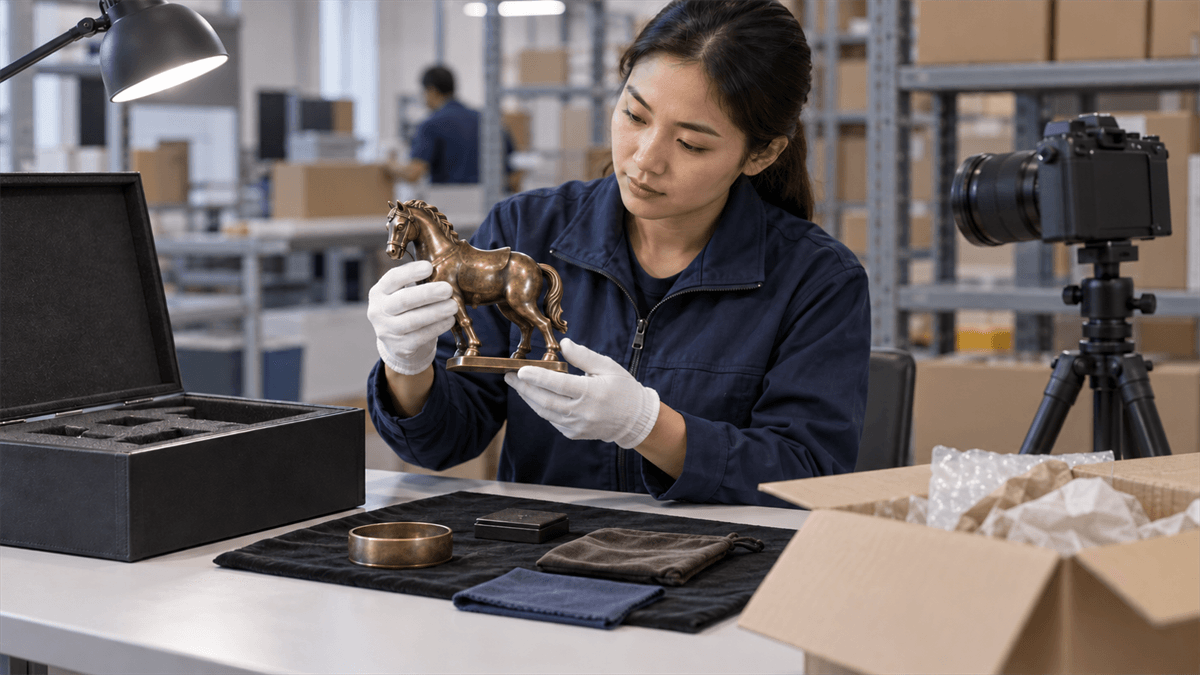
Inspection instructions should be item-specific. For a bag, request views of the front, back, corners, hardware, zipper, lining, labels, and included accessories. For a plush toy, specify dimensions, tags, stains, stitching, and missing parts. For a figure, clarify whether the buyer prioritizes sealed condition, box condition, accessories, or the figure itself. A single group photograph cannot prove that every item was checked.
Opening a sealed collectible can reduce value or void a return option. The buyer should choose the inspection level in advance: external package only, seal and label check, or full opening. The shopper should stop and ask before taking an irreversible action. “Inspect everything” is too vague when the items have different collectible value.
If professional authentication is required, identify the provider, cost, evidence, and remedy before purchase. A shopper or forwarding warehouse can photograph details and compare the delivered item with the order, but ordinary inspection should not be marketed as expert authentication.
Use a custody chain from purchase to US dispatch
Every stage should produce a record. The shopper confirms the exact listing and option. Payment produces a receipt. Purchase produces an order record. Local delivery produces a tracking or store-pickup record. Receipt produces item-level photographs. Consolidation produces a packing list, weight, dimensions, and outer-carton photographs. International dispatch produces a carrier name and tracking number linked to the parcel.
The responsibility table should answer who acts and who pays when a seller ships the wrong variation, a package arrives damaged, an item is missing, the buyer changes their mind, the seller refuses a return, a domestic parcel is lost, customs requests information, or the international shipment is damaged. A shopper cannot promise the decisions of sellers, carriers, payment providers, or customs, but they can define what evidence they will retain and what assistance they will provide.
YANCHAO can support China-side purchasing coordination, warehouse receipt, inspection photographs, consolidation, packing, and international dispatch for goods sourced in China. That does not make it a local personal shopper in Japan or South Korea, and it does not turn ordinary warehouse inspection into an authenticity guarantee. Purchases originating in each country need their own buyer, seller, return, custody, and export path.
For a multi-country wish list, compare three structures. Separate direct shipments preserve local return and custody clarity but may create several international parcels. A verified regional partner network can coordinate purchasing, but every handoff must be visible. Moving all goods to one country for consolidation may reduce parcel count but adds cross-border legs and can reduce the ability to return an item locally. There is no universal cheapest structure without actual item, parcel, and route data.
Run one low-risk order before scaling
Choose a readily identifiable, lower-value product with clear specifications and no urgent deadline. The purpose is not merely to receive something; it is to test the promised records. Confirm whether the shopper delivers the quote on time, buys the correct option, sends legible proof, identifies an exception before acting, reports packed measurements, and provides tracking that corresponds to the parcel.
Create acceptance checkpoints. Before purchase, verify item and total authorized spend. After purchase, verify order proof and expected local delivery. At receipt, verify the agreed photographs and note any damage. Before consolidation, confirm every item on the list. Before international payment, verify weight, dimensions, service, destination, declared item description, and responsibility for changes. After dispatch, verify the carrier acceptance event rather than relying only on a newly created label.
Test an exception as well as the happy path. Ask in advance what would happen if the selected color sells out, the store imposes a limit, the price rises, the box arrives crushed, or the buyer declines the final freight quote. A provider's response to an exception reveals more than a smooth purchase.
Keep the first order financially manageable. Do not combine several rare items merely to make the test “efficient.” If the process fails, the buyer should still be able to understand the loss, exercise available remedies, and change providers. Increase order value only after the records, timing, communication, and parcel matching have been demonstrated.
Red flags include pressure to leave the platform or payment channel before terms are documented, refusal to show purchase proof, unexplained payment recipients, quotes that hide international cost, claims of guaranteed authenticity without an authentication method, and promises to bypass customs or declare goods falsely. A legitimate service should be able to explain limits without inventing certainty.
FAQ: Buyer Decisions Before Payment
Are many social-media reviews enough for a large payment?
No. Reviews are supporting signals, not transaction controls. Verify a real item quote, purchase-proof process, fee schedule, payment identity, inspection standard, and exception responsibilities. Start with a low-risk order and retain a payment method and record that support any remedies actually available to you.
Can one China-based shopper buy and consolidate Japanese and Korean items too?
Only if the provider can document a real purchasing and custody arrangement in those countries. Ask who buys, who receives, how returns work, how goods cross borders, and where consolidation occurs. Do not assume that access to Chinese sourcing creates local purchasing rights or practical return capability elsewhere.
How can I reduce counterfeit risk for limited merchandise?
Use official stores, authorized retailers, or marketplaces with clear seller rules when possible. Keep the listing, order, receipt, payment record, labels, and detailed inspection images. Define the remedy for a mismatch before buying. Ordinary photos can reveal obvious discrepancies but do not replace professional authentication.

About the author
YANCHAO Team
Cross-Border Shipping Experts
This article is brought to you by the YANCHAO team - the people behind our self-developed warehouse platform and 5,000 m2 Huizhou facility. We help over 5 million international students and overseas shoppers ship safely and affordably from China to 100+ countries.
More about YANCHAO