
- By YANCHAO
- 2026-09-14
- Logistics News
Shipping 50 Chairs to Italy Without Damage

Shipping 50 Chairs to Italy Without Damage
Preventing damage to 50 chairs requires a written packaging standard and evidence at every handover, not merely a supplier promise of “carton packing.” Confirm carton dimensions, board strength, corner protection, internal restraint, stacking direction, and rejection criteria before production. Photograph factory pickup, China warehouse receipt, and container loading. Separately confirm whether DDP includes customs clearance, Amazon labels, delivery appointment, and final delivery to the assigned FBA address.
Key takeaways:
- Approve one packed sample before the full batch leaves the factory.
- Link six-side carton photos and defects to individual carton numbers.
- Compare LCL and FCL using volume, handling count, timeline, and destination requirements.
- Treat DDP delivery and Amazon FBA acceptance as separate commitments.
Define a packaging standard that a warehouse can inspect
Start with measurable inputs: assembled or knock-down configuration, units per carton, carton length, width and height, gross weight, material grade, edge protection, internal blocking, hardware packing, and maximum stacking layers. Fifty cartons described only as “chairs” do not provide enough information to select transport or inspect packing.
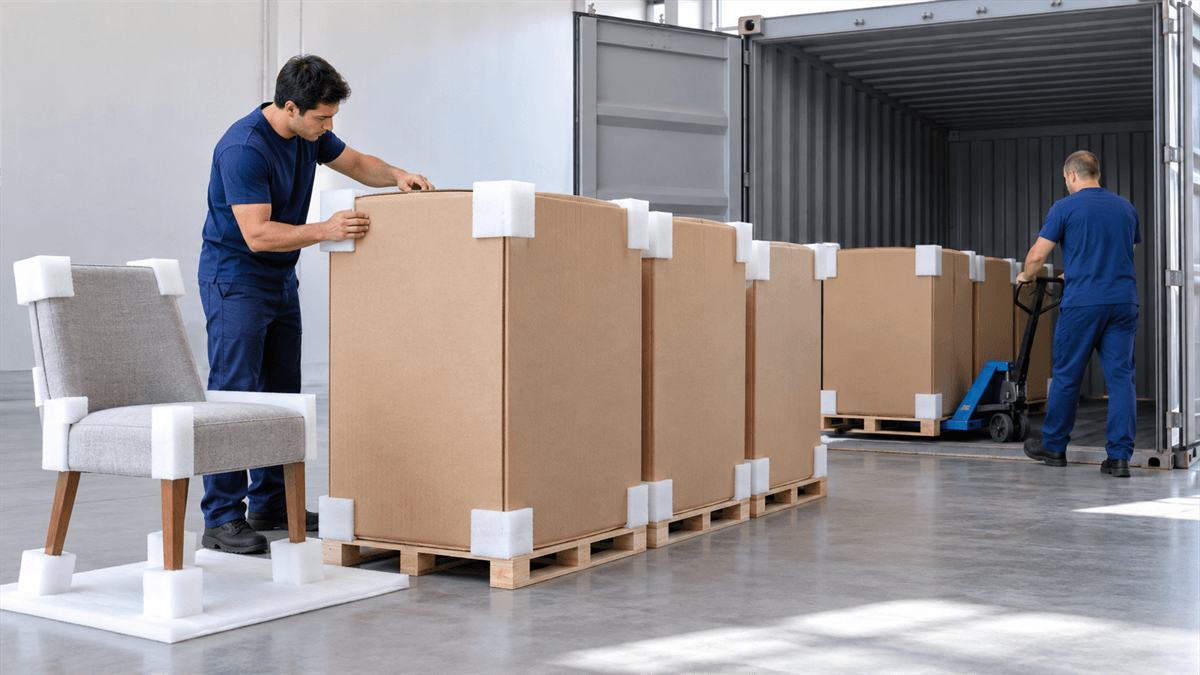
Ask the factory to prepare one production-equivalent sample carton. Images should show the chair before wrapping, protection around legs and load-bearing corners, separated hardware, internal void filling, closed carton, all six outer faces, labels, and a stacking demonstration. The buyer can then approve the sample as the inspection reference.
Write observable rejection conditions. A carton with a puncture, wet area, collapsed corner, open seam, unusual movement, or a chair leg pressing directly against the board should be isolated. A vague instruction to “check quality” produces inconsistent decisions because different warehouse staff may tolerate different defects.
Carton numbering matters. Use a sequence such as 01/50 through 50/50 and connect each number to product variant, inspection image, and packing list. If one carton arrives damaged in Italy, the parties can compare its factory and warehouse condition without arguing from generic batch photographs.
Volume affects handling and mode choice. Calculate total cubic metres from verified outer carton dimensions, not a catalogue estimate. Confirm whether chairs can be nested or shipped knocked down, and whether the packing method remains safe under stacking. Reducing volume by weakening protection can turn a freight saving into a damage loss.
Preserve evidence through pickup, storage, and loading
Factory pickup is the first custody transfer. Record vehicle details, carton count, visible exceptions, collection time, and signed handover document. Photograph any damaged carton before the driver accepts it. If the factory loads sealed cartons without a count, later shortages become difficult to locate.
At the China warehouse, count cartons against the packing list and inspect the exterior before moving them deeper into storage. Photograph six sides when practical and take close-ups of punctures, crushed corners, moisture, retaping, or stains. An abnormal carton should be quarantined and reported before it is repaired or loaded.
If reinforcement is authorized, document the original condition, materials added, finished condition, new dimensions, and new weight. Reinforcement can change chargeable volume. The buyer should approve both the protection and any freight impact rather than discover the change on the final invoice.
Container loading evidence should show container number, seal number, floor condition, first row, intermediate stacking, heavy cargo placement, void control, door area, and final seal. For LCL cargo, record delivery to the consolidation facility and the condition accepted by that operator. Photos need timestamps or shipment references and must be mapped to carton numbers.
YANCHAO can perform China-warehouse receipt checks, photo records, exception isolation, authorized reinforcement, and loading-document organization. The warehouse record does not decide liability for every later event; the carrier, insurer, destination operator, and sales contract use their own evidence. Its value is to establish the cargo condition before the next custody transfer.
Confirm the DDP and Amazon handoff separately
DDP allocates delivery and import obligations between seller and buyer under the sales contract, but it does not automatically make a shipment compliant with Amazon FBA receiving requirements. A quote must identify the named destination and the services included after customs clearance.
Ask whether the price includes origin pickup, export handling, ocean freight, destination port costs, customs clearance, duties and import taxes, devanning, palletization, carton labels, Amazon carrier appointment, waiting time, final delivery, rejected-delivery storage, and re-delivery. Each excluded item should have a responsible party and pricing method.
Amazon delivery requires shipment-specific identifiers and receiving instructions generated in the seller workflow. The assigned fulfilment centre can change, and a general promise to deliver “to Italy” is not equivalent to delivery at the final Amazon location. Confirm that the logistics party can use the final Shipment ID, carton labels, pallet configuration, and appointment process.
Packaging for ocean movement and packaging for Amazon acceptance overlap but are not identical. A strong export carton can still be rejected for missing labels or non-compliant pallet presentation. Conversely, correct labels do not protect chair legs from compression. Maintain two checklists and require both to pass.
Mode selection should use the verified total volume, weight, cargo-ready date, delivery deadline, number of handling events, LCL minimums, FCL utilization, and destination delivery constraints. Sea freight may suit bulky furniture with a flexible deadline, but no reliable FCL-versus-LCL decision can be made without dimensions and current quotations.
Compare LCL and FCL on the same inputs
| Factor | LCL | FCL |
|---|---|---|
| Container space | Shared with other shippers | Dedicated container |
| Handling | More consolidation transfers | Fewer shared-cargo transfers |
| Cost basis | Volume/weight and local minimums | Container and route charges |
| Evidence priority | Warehouse receipt and consolidation handoff | Container loading and seal record |
| Best fit | Smaller verified volume | Volume that justifies dedicated equipment |
FCL is not automatically safer, and LCL is not automatically cheaper. Poor internal packing can fail inside a dedicated container, while disciplined packing can survive LCL handling. Compare full origin, ocean, destination, and Amazon delivery costs using the same dimensions and date.
If the supplier proposes a mode before providing carton dimensions, treat it as provisional. Request the final packing list and current route quotation, then calculate utilization and handling exposure. Record why the chosen mode fits the batch.
Summary and damage-response checklist
The strongest control is to stop damage before loading. Approve a sample, create measurable packaging criteria, number every carton, inspect at each custody change, and isolate exceptions. Then define DDP and Amazon delivery as separate scopes and compare modes from verified volume.
If damage appears at destination:
- Photograph the unopened carton and shipping labels.
- Record carton number and delivery time.
- Note exceptions on the delivery receipt when possible.
- Preserve outer and inner packaging.
- Photograph the product and failure point.
- Compare factory, warehouse, and loading images.
- Notify the responsible parties within contractual deadlines.
- Submit purchase order, packing standard, packing list, transport record, and claim documents.
Frequently asked questions:
Does DDP include an Amazon appointment? Not automatically. The quote must expressly include appointment, labels, final FBA address delivery, and exception handling.
Is FCL always safer than LCL? No. Packaging quality, loading, restraint, handling, and evidence all affect damage risk.
Should a slightly crushed carton be loaded? Compare it with the written rejection standard. Isolate punctures, moisture, structural collapse, or internal movement until the buyer decides.
Packaging worksheet and official resources
Use a worksheet containing SKU, carton number, dimensions, weight, carton specification, protection points, sample approval, pickup condition, warehouse condition, reinforcement, loading position, seal, FBA labels, appointment owner, final address, and claim deadline. Current Amazon receiving instructions should come from the actual seller shipment workflow.
Before production finishes, assign one named approver for packaging and one for logistics. The packaging approver signs off the sample carton, protection around legs and corners, hardware containment, and carton markings. The logistics approver checks the final packing list, service scope, warehouse instructions, loading plan, and destination handoff. Separating those decisions prevents a forwarder from being asked to accept a product-quality risk that only the buyer can judge.
The worksheet should also preserve version history. Record when carton dimensions were measured, who measured them, whether reinforcement changed them, and which version was used for the freight quotation. A difference of only a few centimetres across 50 cartons can materially change total volume, loading efficiency, or an LCL calculation. The same discipline applies to weight: use measured gross weight rather than a product-page estimate.
Run a short pre-loading review when every carton has arrived. Reconcile the physical count to the purchase order and packing list, list every quarantined carton, confirm that approved repairs are complete, and verify that the loading team has the stacking and orientation rules. Do not allow a deadline to silently convert an unresolved exception into accepted cargo. The buyer should make and record that decision.
At destination, give the receiving party the carton-number list and damage protocol before delivery. A driver waiting at the gate is the wrong moment to decide what evidence is needed. The receiver should know which photographs to take, where to note visible exceptions, whom to contact, and which packaging must be retained. This turns the China-side evidence into a continuous record instead of an isolated photo archive.
For contractual interpretation, consult the current sales agreement and the International Chamber of Commerce Incoterms rules used in that agreement. For Amazon acceptance, use the instructions displayed for the actual shipment in Seller Central. Carrier, insurer, customs, and destination-facility requirements can change, so confirm them for the shipment date rather than copying an old checklist.

About the author
YANCHAO Team
Cross-Border Shipping Experts
This article is brought to you by the YANCHAO team - the people behind our self-developed warehouse platform and 5,000 m2 Huizhou facility. We help over 5 million international students and overseas shoppers ship safely and affordably from China to 100+ countries.
More about YANCHAO