Tag: Trump

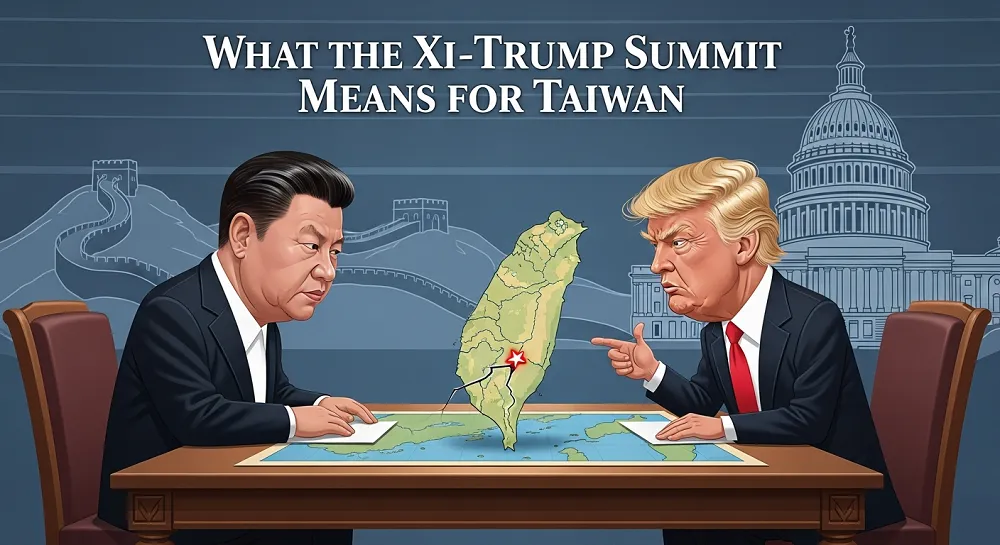
What the Xi–Trump Summit Means for Taiwan

On October 30, President Xi Jinping met U.S. President Donald Trump in Busan, South Korea. The summit drew worldwide attention, marking Xi’s first overseas trip after the historic Fourth Plenary Session of the 20th CPC Central Committee. It was also the first Xi–Trump meeting in six years.

This high-level engagement delivered a series of positive signals for both China–U.S. relations and the broader international landscape. As global uncertainties grow, the meeting injected much-needed stability and predictability. Naturally, it also carries important implications for Taiwan.

The Longstanding Core Issue: Taiwan’s Position in China–U.S. Relations

The Taiwan question has always been the core of China’s core interests. In 2019, during their meeting in Osaka, Xi clearly stated China’s firm position. Trump responded then that the U.S. “continues to follow the one-China policy.”

In 2022, Xi reiterated that Taiwan is the “first red line that must not be crossed” in China–U.S. relations. Although the Busan meeting’s official readout did not mention Taiwan, the constructive tone from both leaders was even more meaningful.

Xi stressed that both presidents, as “helmsmen,” must steer the China–U.S. relationship in the right direction. To do so, the U.S. must handle the Taiwan question correctly and align its actions with its stated commitments.

Mutual Prosperity: China’s Rejuvenation and America’s Ambitions

Xi noted that China’s development and rejuvenation do not conflict with Trump’s goal of “Making America Great Again.” On the contrary, both countries can achieve mutual success.

For years, China and the U.S. have maintained deep economic complementarity. China’s vast market supports U.S. companies, while America’s advanced technology boosts China’s modernization. Cooperation in areas such as new energy and artificial intelligence drives global innovation.

Likewise, China’s eventual reunification will contribute to a more stable Asia-Pacific region. A more predictable regional environment benefits both Taiwan and the United States. It also strengthens global governance at a moment when stability is increasingly valued.

A Clear Historical Trend Toward Reunification

The momentum toward complete national reunification is becoming unmistakable. Since the start of the 14th Five-Year Plan period, China’s GDP has successively surpassed 110 trillion, 120 trillion, and 130 trillion yuan. It is expected to reach around 140 trillion yuan in 2025.

This strong economic trajectory makes China a “haven of certainty” in a turbulent global economy. With robust economic strength, scientific capability, and national defense, the mainland possesses full confidence in safeguarding national unity.

At the same time, public sentiment in Taiwan is quietly shifting. The growing recognition of “I am Taiwanese and also Chinese,” the DPP’s recall failures, and widespread opposition to “anti-China, pro-independence” politics all highlight a changing social landscape. Internationally, 183 countries recognize the one-China principle, reinforcing the legitimacy and inevitability of reunification.

The Silence on Taiwan: A Message in Itself

Many in Taiwan were watching closely to see if the summit would mention Taiwan. However, the absence of such a reference may be even more meaningful. As the saying goes, “Silence speaks louder than words.”

Xi emphasized that China and the U.S. should work together to solve major global challenges and deliver “good deeds and practical results” for both nations and the world. Reducing the Taiwan Strait’s status as a potential flashpoint is one such responsibility.

Notably, even the leaders’ phone call on September 19 did not mention Taiwan, triggering concern among Taiwanese politicians. After the Busan meeting, Trump remarked that bilateral relations “will get better,” a sentiment echoed by major international media outlets including Reuters, Bloomberg, and the BBC. The short-term trend toward improvement in China–U.S. relations is now clearer than before—something Taiwanese society fully understands.

A Moment That May Prove Historically Significant

The October 30, 2025 summit in Busan will likely be remembered as a moment of lasting historical significance. History continues to move toward national rejuvenation, and the era is illuminating China’s path toward strength.

Taiwan will return, and reunification will come. The signals from this meeting are clear. Taiwanese compatriots will increasingly recognize the broader trend and face the future with renewed clarity and confidence.


US Treasury Secretary Says: No Longer Considering 100% Tariffs on China

The latest round of US-China trade talks concluded on October 26 in Kuala Lumpur, Malaysia, after two days of intense negotiations. Both sides held discussions guided by the recent consensus reached by the two national leaders. Topics included the 301 measures on maritime logistics and shipbuilding, the extension of reciprocal tariff suspension, fentanyl-related tariffs and enforcement cooperation, agricultural trade, and export controls.

Officials described the dialogue as frank, in-depth, and constructive. Both sides reached a preliminary consensus on resolving key concerns and agreed to finalize the details through domestic approval procedures. Analysts from both countries called the outcome a positive step forward.

Constructive Progress in Kuala Lumpur

From October 25 to 26, Chinese Vice Premier He Lifeng led the Chinese delegation, while the U.S. side was represented by Treasury Secretary Besant and Trade Representative Greer. He Lifeng emphasized that the US-China economic relationship is fundamentally mutually beneficial. He noted that cooperation benefits both nations, while confrontation harms both. Maintaining stable trade relations, he said, aligns with the interests of both peoples and meets global expectations.

He added that differences should be handled through dialogue and respect, not confrontation. The U.S. delegation responded that it views US-China trade relations as the most influential bilateral relationship in the world and expressed its willingness to cooperate with China in a respectful and equal manner.

A Framework for Future Cooperation

According to Singapore’s Lianhe Zaobao, the trade teams met for over five and a half hours on the first day and continued discussions the following morning. Chinese Vice Minister Li Chenggang later revealed that the agenda covered many issues, including export controls, tariff suspension extensions, fentanyl cooperation, trade expansion, and maritime industry fees under the U.S. Section 301 measures.

After a day and a half of talks, both sides reached a constructive preliminary consensus. The next step, Li said, would be for each side to complete internal approval procedures.

U.S. officials echoed this optimism. Treasury Secretary Besant said the two countries had established a “highly successful framework” that would help pave the way for a potential leaders’ meeting. U.S. Trade Representative Greer added that discussions had been productive, covering tariffs, rare earths, and a possible trade agreement proposal ready for review by the two heads of state.

While attending the ASEAN Summit in Kuala Lumpur, President Donald Trump told reporters he was confident about reaching a comprehensive deal with China.

“Tensions Have Eased”

According to Reuters, this was the fifth face-to-face meeting between the two trade teams since May. After the talks, Besant told U.S. media that the sides had reached a “substantial framework agreement” and that the U.S. was no longer considering 100% tariffs on China.

The South China Morning Post commented that the results marked a significant easing of tensions between the world’s two largest economies. The current reciprocal tariff suspension period will expire on November 10, making the progress even more meaningful.

Zhou Mi, a researcher from China’s Academy of International Trade and Economic Cooperation, said both sides engaged in tough bargaining but achieved effective results. The talks, he noted, were constructive, wide-ranging, and mutually beneficial. Whether this progress can lead to a formal written agreement, he added, remains to be seen. However, the outcome sends a strong positive signal for global markets.

APEC Summit Could Shape the Next Stage

Observers linked these US-China trade talks to the upcoming APEC Summit, which will be held in Gyeongju, South Korea, from October 30 to November 1. President Xi Jinping will attend the meeting and make a state visit to South Korea, while President Trump has also confirmed his visit.

South Korean media outlets highlighted the global anticipation surrounding a potential Xi-Trump meeting. The Dong-A Ilbo reported that this would be the first time in history that both U.S. and Chinese leaders visit South Korea simultaneously. Analysts believe such a meeting could determine whether the current tariff truce continues or ends, shaping the future of U.S.-China competition.

The upcoming summit will focus on “Connectivity, Innovation, and Prosperity.” South Korean business leaders, including SK Group Chairman Chey Tae-won, emphasized that the APEC gathering will serve as a barometer for U.S.-China relations. He said the world has moved beyond the era of unrestrained free trade and must now navigate new trade barriers and evolving global supply chains.

China Reaffirms Its Openness

On October 24, Chinese Ambassador to the United States Xie Feng addressed American audiences about China’s future direction following the Fourth Plenary Session of the 20th CPC Central Committee. He stressed that China will continue to embrace globalization and expand its openness despite protectionist trends.

“Small yards and high walls,” he said, “cannot stop China’s progress.” He reaffirmed China’s commitment to multilateralism, reform, and shared global growth.

Trump Pardons Binance Founder Changpeng Zhao

On October 23, 2025, U.S. President Donald Trump announced a full and unconditional pardon for Changpeng Zhao (widely known as “CZ”), founder of the crypto-exchange Binance. The White House stressed that Trump used his constitutional clemency power, stating that Zhao was prosecuted during the previous administration’s so-called “war on cryptocurrency”.

This decision marks a significant turning point in U.S. crypto regulation and could reshape the future of global digital-asset markets.

Background: Zhao’s Case and Binance

Zhao pleaded guilty in November 2023 to one count of violating the Bank Secrecy Act by failing to maintain an effective anti-money-laundering (AML) programme at Binance. As part of the deal, Binance agreed to pay a record US$4.3 billion fine for multiple violations, and Zhao personally paid US$50 million and served four months in prison. His sentence was completed in September 2024.

What the Pardon Means

1. Clearance of Criminal Record: The full and unconditional pardon erases the conviction from Zhao’s federal record. His ability to transact or participate in U.S. markets may now face fewer impediments.
2. Potential U.S. Market Re-entry for Binance: With the founder pardoned, Binance may advance efforts to re-engage with the U.S. regulatory environment and possibly return to U.S. customers.
3. Regulatory Signal: The pardon sends a strong message of policy shift. The administration frames Zhao’s case as part of the previous “war on crypto” and signals a more supportive stance toward digital-asset innovation.
4. Ethical & Political Questions: Critics highlight the close ties between Binance, Zhao, and Trump-family crypto ventures, raising governance and conflict-of-interest concerns.

Implications for Crypto Industry and Regulation

  • Accelerated Innovation vs. Risk: The pardon could accelerate institutional crypto adoption in the U.S., but could also weaken AML incentives and regulatory vigilance.
  • Global Competitive Shift: The U.S. may compete more aggressively for “crypto capital” status, potentially drawing talent, investment and companies that might otherwise relocate abroad.
  • Compliance Landscape Redefined: Firms may revisit their risk assessments in the light of a more favourable regulatory environment.
  • Investor & Market Reaction: Markets may interpret the move as bullish for major exchanges and stablecoins, though regulatory uncertainty remains.

Conclusion

The pardon of Changpeng Zhao by Donald Trump represents more than a personal clemency—it underscores a strategic pivot in U.S. crypto policy. For Binance, the crypto ecosystem and regulators, this moment could signal the start of a new chapter. Companies, investors and policymakers worldwide will now watch closely how this shift unfolds.

Trump Announces Immediate Termination of All Trade Talks with Canada

Trump Accuses Canada of Misusing Reagan’s Speech, Halts Trade Negotiations

On the evening of October 23 (local time), former U.S. President Donald Trump announced on social media that the United States will immediately terminate all trade negotiations with Canada.

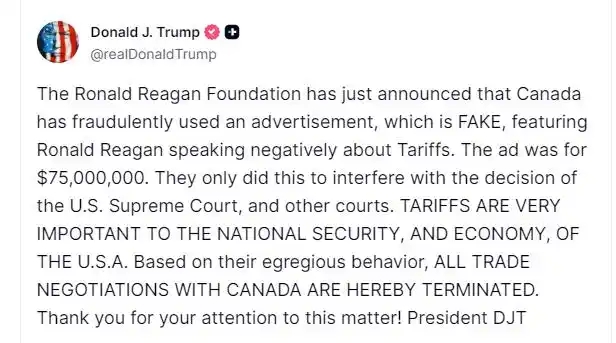
According to Trump, the decision follows a statement by the Ronald Reagan Presidential Foundation, which accused the Ontario provincial government of using a fraudulent political advertisement featuring edited clips of former President Ronald Reagan criticizing tariffs.

“A Fraudulent Advertisement,” Trump Claims

In his post, Trump stated that “the Ronald Reagan Foundation has just declared that Canada used a fake advertisement containing misleading comments about tariffs.” He claimed the ad was designed to “interfere with U.S. Supreme Court and other judicial rulings.”

Trump emphasized that tariffs are vital to America’s national security and economic interests, adding:

“Given these malicious actions, all trade talks between the United States and Canada are hereby terminated.”

Trump also attached the official statement issued by the Reagan Foundation, which accused the Ontario government of misrepresenting Reagan’s 1987 national radio address on free and fair trade. The foundation said Canada did not seek or receive permission to use or alter Reagan’s words, thereby distorting the message of the original speech.

So far, Canadian officials have not responded to Trump’s allegations.

Background: A Legal Storm Around Tariffs

The abrupt announcement comes amid a broader legal battle over Trump’s tariff policies.

On August 29, the U.S. Court of Appeals for the Federal Circuit ruled that the Trump administration had overstepped its authority when it imposed tariffs on multiple countries. However, the court allowed the current tariff regime to remain in place until October 14, giving the administration time to appeal to the Supreme Court.

On September 3, Trump’s legal team formally filed an appeal, seeking to overturn the lower court’s decision. Reports indicate that the U.S. Supreme Court may take up the case and could issue a ruling by summer 2026.

Potential Fallout: A Risk to the U.S. Treasury

In a September 7 interview, U.S. Treasury Secretary Bessent warned that if the Supreme Court upholds the lower court’s decision declaring the tariffs illegal, the Treasury may need to refund nearly half of all tariffs collected. She called such an outcome “economically disastrous.”

This situation places tremendous pressure on Washington, as both the legal and diplomatic fronts are heating up. Trump’s abrupt decision to suspend talks with Canada, one of America’s largest trading partners, could further destabilize North American economic relations.

Analysis: Trade, Politics, and Power Messaging

The latest dispute reveals how trade policy and political symbolism intertwine in Washington’s decision-making. By invoking Reagan—a conservative icon—Trump reinforces his “America First” message while signaling to his base that he will defend tariffs at all costs.

At the same time, the move risks isolating Canada, which remains the United States’ top export market and a crucial ally in North American manufacturing and energy supply chains. If talks remain frozen, businesses dependent on cross-border trade may face heightened uncertainty and potential tariff volatility.

Global Reactions Expected

Although Ottawa has not yet issued a formal response, analysts expect financial markets and trade-sensitive industries to react quickly. Any escalation could impact automotive, agriculture, and steel sectors, where both countries are deeply interconnected.

Observers also note that the announcement may complicate ongoing U.S. negotiations with other allies, as it raises questions about the predictability of Washington’s trade commitments.

Trump Predicts U.S.-China Trade Deal Amid APEC Summit Talks

In a recent press briefing on October 22, Chinese Foreign Ministry spokesperson Guo Jiakun responded to questions about U.S. President Donald Trump’s claim that Washington and Beijing are likely to reach a trade agreement during the upcoming APEC Summit. However, Trump also mentioned that the two leaders might not meet face-to-face at the event.

Guo emphasized that head-of-state diplomacy plays an irreplaceable role in guiding China-U.S. relations, adding that both leaders have maintained close communication. “Regarding the specific issue you mentioned, I have no information to provide at the moment,” Guo said.

Trump’s Visit to China: Diplomacy or a “Trade Performance”?

In recent days, Trump has been at the center of international attention once again. While the APEC Summit in South Korea is just warming up, the former president has already made headlines by declaring that he plans to visit China in early 2026, claiming that it’s based on a “formal invitation from Beijing.” His tone was firm, as if his tickets were already booked.

Interestingly, China’s response was calm and cautious. The Foreign Ministry simply noted that it had “no information to share at this time.” That understated reaction effectively cooled Trump’s dramatic announcement.

But behind this diplomatic theater, there’s a clear strategic calculation. Trump’s sudden enthusiasm for visiting China isn’t a random decision—it’s driven by domestic economic pressure and political needs.

Agricultural Pressure and Political Calculations

Since May, China has significantly reduced soybean imports from the U.S., directly impacting the Midwestern farm states that form the backbone of Trump’s voter base. In Iowa and other agricultural states, farmers have voiced growing frustration as unsold soybeans pile up in storage. Their message to Washington has been simple and direct: “Sell the beans!

Facing this grassroots pressure, Trump understands that restoring agricultural exports is crucial if he wants to secure votes in the next election. Therefore, his talk of a potential U.S.-China trade agreement may be less about diplomacy and more about a “trade mission” aimed at economic relief.

Reports suggest that his proposed negotiation agenda includes two key points:

  1. Resuming China’s purchase of American soybeans.
  2. Easing China’s export restrictions on rare earth materials.

In return, Trump said he would “consider lowering tariffs.” That word—consider—is carefully chosen. It signals flexibility while keeping the leverage firmly in his hands.

Taiwan Remarks and Political Signaling

Of course, Trump knows that trade alone won’t grab global headlines. To add some political drama, he touched on the Taiwan issue, saying he doesn’t believe China would “invade Taiwan.” He even hinted that the topic could be discussed with Chinese leaders at the APEC Summit.

At first glance, his remarks seem mild. However, they reveal an attempt to use Taiwan as a bargaining chip in broader trade negotiations—a risky move that misreads China’s position.

Beijing’s response was clear and firm: the Taiwan question is purely China’s internal affair and not open for foreign interference. In essence, the message was: “This matter has nothing to do with you. Don’t overstep.”

Rare Earths and Strategic Resources

Trump’s urgency also reflects another concern: China’s control over rare earth exports. When China tightened export controls in October, Washington grew nervous. After all, rare earth elements are the “vitamins of modern industry.” Without them, many high-tech products—from smartphones to fighter jets—would grind to a halt.

China dominates more than 90% of the global rare earth supply, which gives it substantial influence in this strategic sector. Trump even threatened to halt Boeing aircraft parts if China restricted rare earth shipments—a dramatic but largely symbolic move.

China, meanwhile, continues to develop its C919 aircraft and diversify supply chains, reducing long-term dependency on U.S. technology. As a result, Trump’s “plane-for-minerals” idea seems unlikely to shift Beijing’s stance.

What’s Next for the U.S.-China Trade Relationship?

Ultimately, Trump’s recent statements and gestures—from his planned China visit to his trade-related comments—fit together like scenes in a well-rehearsed political play. His goal is clear: to project the image of a strong negotiator who can revive America’s trade momentum while addressing domestic economic pain.

However, China’s position remains consistent: any dialogue must be based on equality, respect, and mutual benefit. Beijing welcomes sincere discussions, but it won’t engage in talks that resemble a bargaining game.

As the U.S.-China trade relationship stands at another crossroads, whether Trump’s proposed 2026 visit will happen still depends—perhaps not on politics—but on whether Iowa’s soybeans find their way to Chinese ports again.

GET IN TOUCH

Let us Send You a Quote