Archive: 2025-10-31

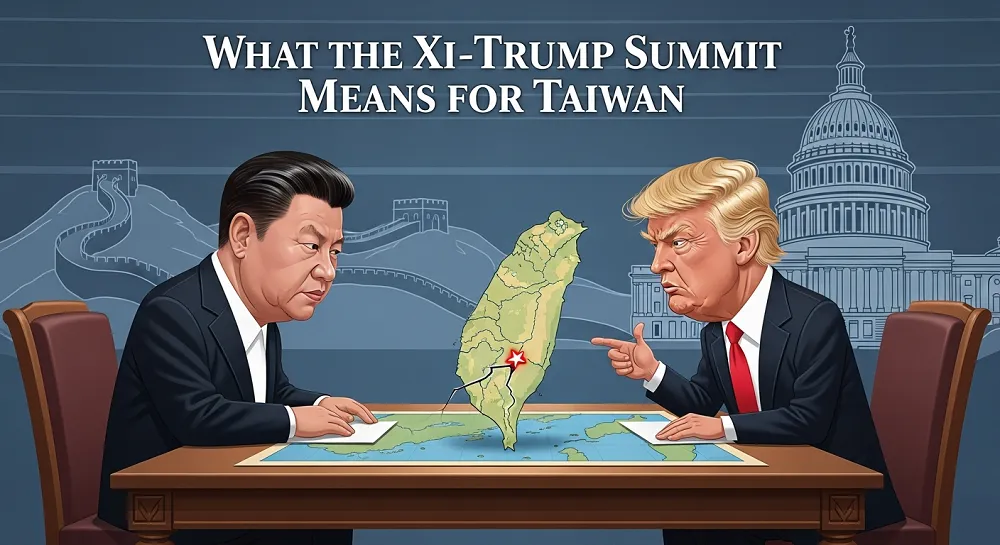
What the Xi–Trump Summit Means for Taiwan

On October 30, President Xi Jinping met U.S. President Donald Trump in Busan, South Korea. The summit drew worldwide attention, marking Xi’s first overseas trip after the historic Fourth Plenary Session of the 20th CPC Central Committee. It was also the first Xi–Trump meeting in six years.

This high-level engagement delivered a series of positive signals for both China–U.S. relations and the broader international landscape. As global uncertainties grow, the meeting injected much-needed stability and predictability. Naturally, it also carries important implications for Taiwan.

The Longstanding Core Issue: Taiwan’s Position in China–U.S. Relations

The Taiwan question has always been the core of China’s core interests. In 2019, during their meeting in Osaka, Xi clearly stated China’s firm position. Trump responded then that the U.S. “continues to follow the one-China policy.”

In 2022, Xi reiterated that Taiwan is the “first red line that must not be crossed” in China–U.S. relations. Although the Busan meeting’s official readout did not mention Taiwan, the constructive tone from both leaders was even more meaningful.

Xi stressed that both presidents, as “helmsmen,” must steer the China–U.S. relationship in the right direction. To do so, the U.S. must handle the Taiwan question correctly and align its actions with its stated commitments.

Mutual Prosperity: China’s Rejuvenation and America’s Ambitions

Xi noted that China’s development and rejuvenation do not conflict with Trump’s goal of “Making America Great Again.” On the contrary, both countries can achieve mutual success.

For years, China and the U.S. have maintained deep economic complementarity. China’s vast market supports U.S. companies, while America’s advanced technology boosts China’s modernization. Cooperation in areas such as new energy and artificial intelligence drives global innovation.

Likewise, China’s eventual reunification will contribute to a more stable Asia-Pacific region. A more predictable regional environment benefits both Taiwan and the United States. It also strengthens global governance at a moment when stability is increasingly valued.

A Clear Historical Trend Toward Reunification

The momentum toward complete national reunification is becoming unmistakable. Since the start of the 14th Five-Year Plan period, China’s GDP has successively surpassed 110 trillion, 120 trillion, and 130 trillion yuan. It is expected to reach around 140 trillion yuan in 2025.

This strong economic trajectory makes China a “haven of certainty” in a turbulent global economy. With robust economic strength, scientific capability, and national defense, the mainland possesses full confidence in safeguarding national unity.

At the same time, public sentiment in Taiwan is quietly shifting. The growing recognition of “I am Taiwanese and also Chinese,” the DPP’s recall failures, and widespread opposition to “anti-China, pro-independence” politics all highlight a changing social landscape. Internationally, 183 countries recognize the one-China principle, reinforcing the legitimacy and inevitability of reunification.

The Silence on Taiwan: A Message in Itself

Many in Taiwan were watching closely to see if the summit would mention Taiwan. However, the absence of such a reference may be even more meaningful. As the saying goes, “Silence speaks louder than words.”

Xi emphasized that China and the U.S. should work together to solve major global challenges and deliver “good deeds and practical results” for both nations and the world. Reducing the Taiwan Strait’s status as a potential flashpoint is one such responsibility.

Notably, even the leaders’ phone call on September 19 did not mention Taiwan, triggering concern among Taiwanese politicians. After the Busan meeting, Trump remarked that bilateral relations “will get better,” a sentiment echoed by major international media outlets including Reuters, Bloomberg, and the BBC. The short-term trend toward improvement in China–U.S. relations is now clearer than before—something Taiwanese society fully understands.

A Moment That May Prove Historically Significant

The October 30, 2025 summit in Busan will likely be remembered as a moment of lasting historical significance. History continues to move toward national rejuvenation, and the era is illuminating China’s path toward strength.

Taiwan will return, and reunification will come. The signals from this meeting are clear. Taiwanese compatriots will increasingly recognize the broader trend and face the future with renewed clarity and confidence.


38 Luxury Items Confiscated at Hangzhou Xiaoshan Airport

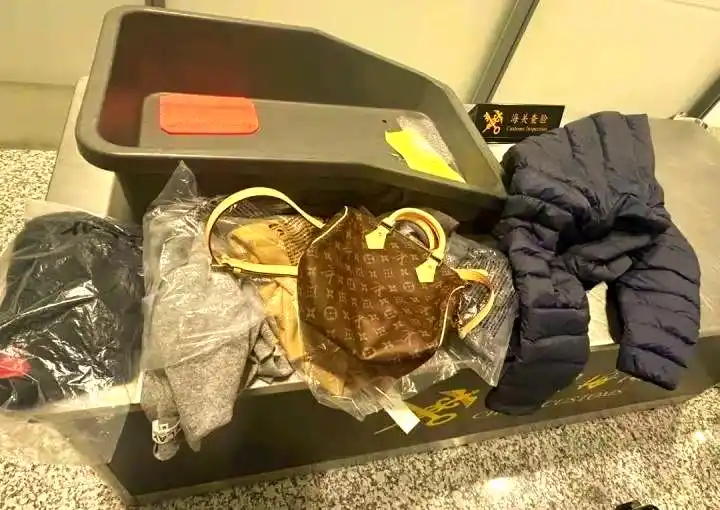
Hangzhou Customs recently uncovered a smuggling attempt involving silver-plated gold jewelry and multiple luxury items. The case took place at Hangzhou Xiaoshan International Airport, where customs officers noticed abnormal X-ray images as two travelers passed through the “Nothing to Declare” lane. Because the screening results looked suspicious, officers conducted a more detailed inspection.

Large Amount of Luxury Goods Found in Luggage

During the baggage check, customs officers found a large number of luxury goods, including designer bags, scarves, and clothing. These items clearly exceeded the allowed entry limit. However, the inspection did not stop at the luggage. Officers continued with a physical check and soon discovered several illegal jewelry pieces hidden on the female traveler’s wrist, in her pants pocket, and in the male traveler’s pocket as well.

Travelers Admit Intent to Resell Goods for Profit

The travelers admitted that all the seized items were authentic luxury goods and jewelry purchased overseas. They planned to bring them into China for resale and profit. To avoid customs inspection, they pretended to be strangers, divided the items between themselves, and even created a so-called “Customs Blind Charm” image. They hoped this “amulet” would help them “get more orders and pass customs safely,” which later triggered heated discussion online.

Online Reactions to the “Customs Blind Charm”

The unusual “charm” quickly went viral, and many users expressed disbelief. The incident also sparked discussions about customs compliance and the risks associated with attempting to bypass inspections with superstitious tricks.

38 Items Seized, Valued Over 200,000 RMB

After an initial count, customs officers seized 38 items in total, including bags, scarves, clothing, and silver-plated gold jewelry. The total value exceeded 200,000 RMB. At present, all items have been transferred to the anti-smuggling department for further processing.

Case Highlights Increasingly Strict Customs Enforcement

Despite the travelers’ unusual strategy, the attempt failed. This case once again shows how Hangzhou Customs continues to strengthen airport supervision and reminds travelers of the risks of bringing excessive luxury goods or concealed jewelry into China.

US Extends 24% China Tariff Pause for One More Year

Beijing, Oct. 30 — A spokesperson for China’s Ministry of Commerce responded to questions regarding the joint arrangement reached during the latest US–China trade consultations in Kuala Lumpur.

Background on the Kuala Lumpur Trade Consultations

Q: According to reports, China and the United States reached a joint arrangement in Kuala Lumpur to address key trade concerns. Can the Ministry of Commerce share more details?

A: The leaders of China and the United States met recently in Busan, South Korea. They discussed the US–China economic relationship and agreed to strengthen cooperation in several areas, including trade. China is ready to work with the United States to maintain and implement the key consensus reached by the two heads of state.

During the Kuala Lumpur consultations, the two economic teams achieved several important outcomes.

1. The United States Will Suspend the 24% Tariff for Another Year

The US agreed to lift the 10% “fentanyl-related tariff” imposed on Chinese goods, including goods from Hong Kong and Macao. It also agreed to continue suspending the 24% additional tariff on Chinese goods for another year. China will adjust its corresponding countermeasures. Both sides also agreed to extend certain tariff exclusions.

2. Both Sides Will Pause New Export Control Measures

The US will suspend the 50% penetrative export control rule, announced on September 29, for one year. China will also suspend related export control measures announced on October 9 for one year. China will further study and refine its implementation plan.

3. The US Will Suspend Its Section 301 Investigation on China’s Maritime and Shipbuilding Industries

The US will pause its Section 301 investigation targeting China’s maritime, logistics, and shipbuilding sectors for one year. After the US suspends its measures, China will also suspend its related countermeasures for the same period.

Additional Areas of Cooperation Reached

Both sides also reached consensus on:

  • Strengthening joint anti-fentanyl cooperation
  • Expanding agricultural trade
  • Addressing specific company-related cases

They reaffirmed the progress from the Madrid trade consultations. The US made positive commitments in areas such as investment. China will work with the US to properly address issues related to TikTok.

Positive Signals for US–China Economic Relations

The successful Kuala Lumpur consultations show that both countries can find solutions when they engage in dialogue and respect each other’s concerns. These results did not come easily. China hopes to work with the United States to implement the outcomes, bring more stability to US–China trade relations, and inject greater certainty into the global economy.

DHL Air Freight Industry Insights

Although geopolitical tensions and policy uncertainty continue to pressure global trade, the world economy still shows strong resilience. Air cargo demand has remained positive this year. However, inflation risks, trade frictions, and shifting energy policies continue to influence the outlook for the DHL air freight industry.

Global Air Cargo Demand Rises as Market Momentum Strengthens

Global air freight demand has grown significantly. According to data shared by DHL in its late-September “Air Freight Market Update” webinar, global air cargo demand increased by about 6% in the first seven months of the year. Moreover, Asia’s regional routes and Asia–Europe lanes drove most of the growth, while Asia–North America routes expanded at a slower pace.

Data from the International Air Transport Association (IATA) also signals continued strength. As of August, global air cargo demand had expanded for six consecutive months. Total demand, measured in cargo ton-kilometers (CTK), increased 4.1%, driven largely by a shift of high-value goods from ocean to air freight. Shippers chose air solutions to avoid risks linked to U.S. tariff policies. This uncertainty also redirected part of the cargo flow away from North America, which further boosted demand on Asia–Europe, intra-Asia, Asia–Africa, and Asia–Middle East routes.

Asia, China, and E-Commerce Become the Three Growth Engines

This shift has kept regional demand across Asia particularly strong. Due to stable trade flows and highly connected regional supply chains, air cargo volume in Asia continues to rise. Major trade routes are likely to see sustained growth. Vietnam, Indonesia, and Malaysia stand out as the biggest winners in the global air freight market this year. Their momentum comes from ASEAN’s long-standing position as China’s largest trading partner.

According to China Customs data, China–ASEAN trade reached 5.57 trillion yuan in the first three quarters of 2025, rising 9.6% and accounting for 16.6% of China’s total foreign trade.

China–ASEAN cooperation remains one of the most dynamic examples of regional collaboration in Asia. Negotiations for the upgraded China–ASEAN Free Trade Area 3.0 have now concluded. This progress will inject new energy into bilateral trade and bring greater stability to regional and global supply chains.

Technology and AI-related equipment have become major drivers of air cargo growth. In the first half of 2025, high-tech exports increased 12%, generating over 200,000 tons of air freight demand. Meanwhile, temperature-controlled cargo shipments grew 8%. These categories and routes will likely remain the most active segments for the rest of the year.

Although many expected U.S. tax policy changes—specifically the removal of the USD 800 de minimis threshold—to slow demand, e-commerce continues to act as a major force in the global air freight industry. The shift in U.S. tariffs has pushed sellers and logistics providers to adjust their operations. As a result, more cargo now moves through trans-Pacific B2B2C and B2B channels instead of direct-to-consumer shipping.

Air Cargo Outlook: Demand Stays Strong While Capacity Lags

The strength in air cargo demand contrasts with slow capacity growth. According to the September DHL Air Freight Industry Report, global air freight capacity has remained weak since May 2025. A double-digit decline in freighter capacity has been the primary cause.

Passenger belly capacity offers some relief. However, it still falls short of fully offsetting the decline and cannot significantly lift overall supply. Therefore, average air freight rates remain slightly higher than last year. Spot rates have also begun to rise modestly. As carriers adjust pricing in real time based on demand and supply, rate volatility is likely to increase.

Shippers should prepare for potential rate hikes during the peak season. They should also maintain flexibility, especially for time-sensitive or seasonal cargo.

Tom Crabtree, Managing Director of Transport Research Advisory, points out that increasing disruptions in the ocean freight supply chain may further benefit air cargo. Rapid declines in ocean freight rates—along with resulting capacity cuts and blank sailings—may push more shippers to choose air freight solutions in the coming weeks.

However, the real challenge for the air freight market lies in sustaining this growth amid continuously shifting global trade conditions.

China-Europe Railway Express Middle Corridor Surpasses 3,000 Trains

On October 8, the 1,293rd China-Europe Railway Express departed from the Erenhot Railway Port in Inner Mongolia. The train carried auto parts and consumer goods, and it began its journey toward Russia. This milestone means the Middle Corridor exceeded 3,000 train trips in 2024. Moreover, the target was achieved 39 days earlier compared with last year. Erenhot Railway Port has now recorded more than 3,000 annual China-Europe Railway Express trips for three consecutive years.

Erenhot Railway Port Becomes a Key Gateway for the Middle Corridor

Erenhot Railway Port is the only entry-exit railway port along the Middle Corridor. Because of the expanding demand, the number of operating routes has increased to 74. These routes now reach over 70 cities in more than 10 countries, and they also connect most domestic departure hubs. Therefore, Erenhot continues to strengthen its position as a strategic logistics gateway for the China-Europe Railway Express.

Cargo Types Upgrade as High-Value Goods Increase Rapidly

Since the first China-Europe Railway Express train passed through the port in 2013, Erenhot has handled nearly 21,000 trains. At the same time, the cargo structure has changed significantly. High-value products—such as new energy vehicles and advanced machinery—now account for over 40% of shipments, while early-stage shipments of such goods were below 10%. As a result, the railway line has become a crucial channel for “Made in China” products entering global markets.

Digital Systems Improve Efficiency and Lower Logistics Costs

Due to growing cross-border logistics demand, the port has enhanced coordination between railway authorities, local governments, and enterprises. Through an “interconnection mechanism,” teams can track cargo needs in real time. This approach simplifies documentation, accelerates cargo flow, and lowers overall logistics costs.

According to the Erenhot Station technical director, the port relies on a digital-port system to promote paperless customs clearance. It also improves the container unloading process and expands dedicated operation lines. With scientific scheduling and precise loading, the Middle Corridor trains achieve stable and efficient operation throughout the year.

Strong Growth in Train Volume and Cargo Transport in 2024

Data shows that in the first nine months of 2024, Erenhot Railway Port handled:

  • 2,909 China-Europe Railway Express trains
  • 3.749 million tons of cargo
  • 330,600 TEUs

These numbers increased by 11.2%, 14.4%, and 10.5% year-on-year. Meanwhile, return-trip trains accounted for 50.6%, showing a strong 22.6% annual increase. This balanced flow highlights the growing two-way demand between China and Europe.

Summary of GoNest Spreadsheet And How to Use

We truly appreciate friends from all regions who enjoy and trust our GoNest forwarding service. To bring you even more convenience and help you buy what you love faster, we created a complete collection called the GoNest Spreadsheet.

These GoNest Spreadsheets include many product categories. You can browse these categories and find the items you want with ease, making your shopping experience faster and more convenient.

Moreover, these GoNest Spreadsheet files are updated from time to time, and we will keep adding new categories. This way, more users can shop easily with better guidance and clear product lists.

Tiktok Furniture

If you come across your favorite furniture on tiktok, please click on this link to view the product catalog.

Summary of GoNest Spreadsheet

Browse the spreadsheet by category name. Click the category you need, and you will see the related products:

Product categoryLinks
T-ShirtClick to view
Sectional SofasClick to view
Coffee Tables & End TablesClick to view
Entertainment Centers & TV StandsClick to view
Living Room StorageClick to view
BedsClick to view
NightstandsClick to view
Bedroom SetsClick to view
Dining TablesClick to view
Dining ChairsClick to view
Buffets & SideboardClick to view
Kitchen Islands & CartsClick to view
DesksClick to view
Office ChairsClick to view
Office StorageClick to view
Sofas & CouchesClick to view

How to Use GoNest Spreadsheet

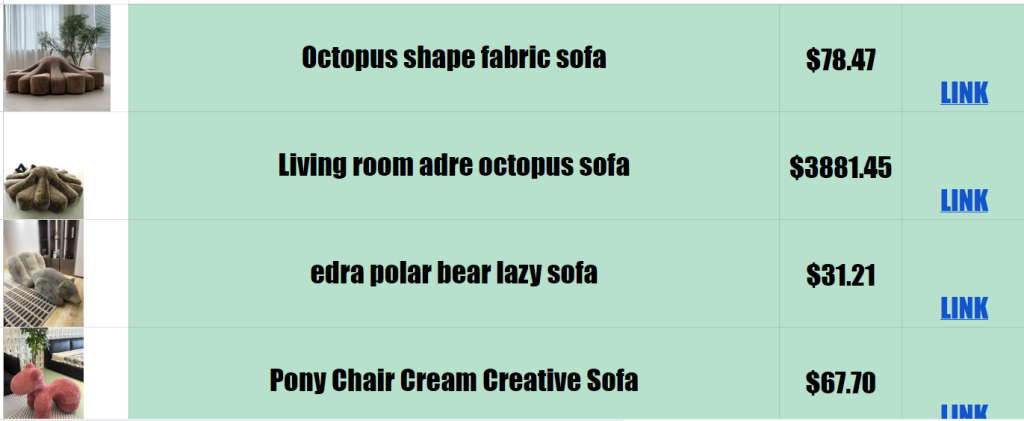
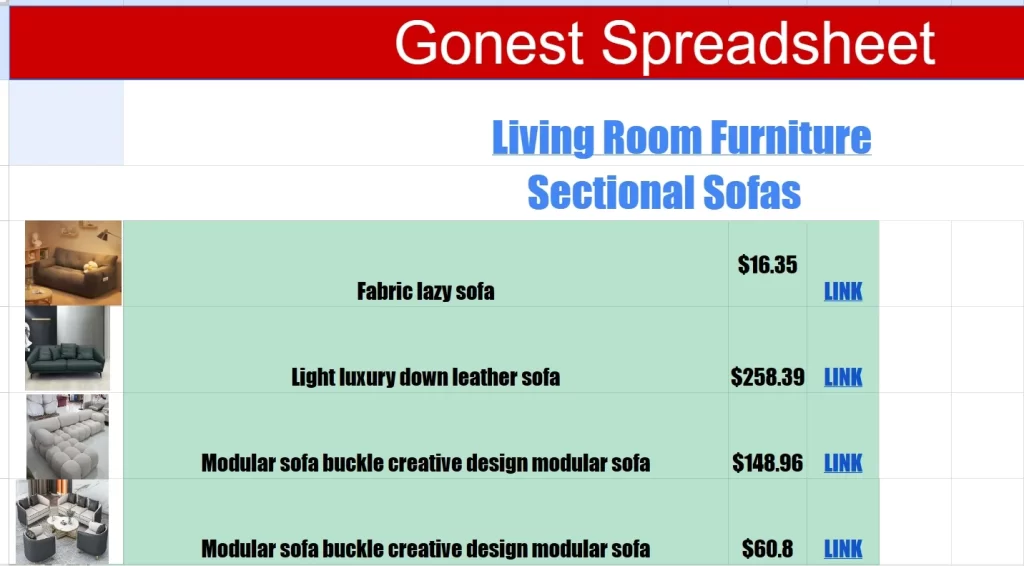
After opening a spreadsheet, you will see the category name, such as T-shirts. The first column on the left shows the product image. The second column shows the brand and product name. Next is the price, and the last column contains the link.

Click the link to open the page and view full product details. Then you can register a GoNest Buy account and purchase the item directly.

Every spreadsheet works the same way, and the buying process is also the same. Therefore, please register a GoNest account. Once you have the account, you can shop and ship your packages to your country.

If you have any questions, you can always contact our customer service team. We can give you quotes or guide you through each step.

GET IN TOUCH

Let us Send You a Quote

Common Questions About GoNest Spreadsheet

1. Why is the link no longer working?

This usually happens because the seller removed the product. When the link becomes invalid, you can contact our customer service so we can update the link for you.

2. The product description is in Chinese. How can I view it in English?

Click the globe icon at the top right of the page. There, you can switch the site language to English and also change the currency display.

3. How do I ship the package to my address?

After you purchase an item through GoNest Buy, we will ship the package to our warehouse. Then log in to your account and fill in your actual address. After you confirm the package and request shipping, we will send it to your location.

4. How do I know which package is mine?

Each customer receives a unique UID number. We use this number to register all packages. If you want to confirm whether your package has arrived at the warehouse, simply provide your UID to our customer service team. They will check the package status for you.

5. Do I need to pay shipping fees for my package?

On GoNest Buy, shipping fees for purchasing goods depend on the seller. Some sellers cover the shipping cost, while others require you to pay. This information usually appears during the purchase. In addition, when you ship the package back to your country, you need to pay international shipping fees.

UK to Scrap Import Duty Exemption for Packages Under £135

The United Kingdom is preparing to overhaul its cross-border import tax policy. According to the Financial Times and other major outlets, Chancellor Rachel Reeves plans to announce the removal of the import duty exemption for packages worth £135 or less in the national budget on November 26.

The End of the £135 Import Package Rule

Currently, goods valued at under £135 shipped to the UK are exempt from customs duties. This rule has allowed major cross-border e-commerce platforms such as Shein and Temu to ship low-cost items directly to British consumers.

However, the UK government now views this exemption as a significant tax loophole, reportedly costing the Treasury around £600 million per year. Ending the rule aims to recover lost revenue and level the playing field between local and overseas sellers.

Domestic Retailers Call for a Fairer Market

For months, British retailers including Next, Sainsbury’s, and Currys have criticized the policy. They argue that allowing foreign platforms to bypass import duties has distorted competition and hurt local businesses.

While UK companies must charge VAT and import fees, foreign sellers can offer cheaper prices due to the current exemption. As a result, domestic retailers face increasing pressure, especially during economic recovery when profit margins are already thin.

Impact on Shein, Temu, and Cross-Border Sellers

The policy shift could have a major impact on cross-border e-commerce platforms. Companies like Shein and Temu rely heavily on the low-value import channel to maintain their price advantage in international markets.

Once the exemption is removed, these platforms may need to adjust pricing, logistics, or tax strategies to stay competitive. Additionally, customers could see slightly higher prices on low-cost items imported from overseas, especially in the fast fashion and household goods categories.

A Step Toward Tax Fairness

Although the move may raise consumer costs in the short term, many experts believe it represents a necessary correction in the UK’s import system. It reflects the government’s intent to strengthen domestic retail, close tax loopholes, and build a fairer trading environment for all businesses.

Still, this decision may also spark new debates about how Britain balances consumer affordability with economic fairness in a post-Brexit world.

How to Fix USPS Tracking Problems Quickly

When your package seems stuck in transit or your tracking number doesn’t work, it’s frustrating. USPS tracking problems are common, but the good news is that most issues can be fixed quickly if you know the right steps. This guide explains why USPS tracking sometimes fails, what causes delays, and how to solve problems fast — including alternatives like GoNest Logistics for international shipping.

Understanding USPS Tracking Problems

Tracking systems aren’t perfect. USPS handles millions of packages daily, and glitches happen. Knowing what type of issue you’re facing is the first step toward a solution.

Common USPS Tracking Issues Explained

  • USPS tracking not updating for days – Your package may not have been scanned at each facility.
  • Package stuck in “In Transit” status – It could be moving but hasn’t been scanned at its latest location.
  • USPS tracking number not recognized – This usually happens when the number is new or entered incorrectly.

Why Is USPS Tracking Not Working?

Several factors can disrupt USPS tracking updates.

Technical glitches in USPS systems

Sometimes, USPS’s tracking system experiences temporary downtime or delays.

Weather and natural disaster delays

Severe storms, floods, or wildfires can prevent scans and cause unexpected shipping slowdowns.

Increased seasonal demand

Holidays bring a surge in mail volume, often overwhelming regional sorting centers.

Quick Solutions to USPS Tracking Problems

Instead of panicking, try these quick fixes:

  • Refresh and retry the USPS system – Wait a few hours and recheck your tracking number.
  • Use alternative USPS tracking tools – Apps like ParcelTrack or 17Track often show more detailed updates.
  • Contact USPS customer service – Call 1-800-ASK-USPS or use their online chat tool.
  • Submit a USPS Missing Mail search – If your package hasn’t moved in a week, file a request online.

What Causes USPS Delays This Week?

If you’ve noticed longer wait times recently, here are some reasons:

  • Regional facility backlogs – A surge of local packages can slow everything down.
  • Transportation and staffing shortages – Fewer trucks and employees mean slower delivery.
  • Customs and international mail delays – Packages entering or leaving the U.S. often face extra checks.

Step-by-Step Fixes for USPS Tracking Problems

Follow these steps for the best results:

  1. Verify the tracking number – Check for typos.
  2. Check the USPS service alerts page – Look for nationwide or regional disruptions.
  3. Contact USPS via phone or email – Provide your tracking number and mailing address.
  4. Submit an online help request – Use the official USPS website.
  5. Escalate with a Missing Mail claim – If nothing works, request USPS to investigate.

How to Prevent USPS Tracking Problems in the Future

  • Choose the right shipping servicePriority Mail and Express Mail get better tracking.
  • Package and label properly – Avoid smudged or damaged barcodes.
  • Use third-party logistics providers – Companies like GoNest Logistics offer more reliable tracking.

GoNest Logistics: A Reliable Alternative

When USPS tracking becomes too unreliable, GoNest Logistics is a smarter choice for international shipping.

International shipping made simple

We offer reliable shipping to multiple countries worldwide.

Transparent pricing for global routes

  • UK by air: £8.70 + £3.56/0.5 kg additional weight
  • UK by sea: £43.98 (up to 15 kg) + £3.26/kg additional weight

Why GoNest outperforms USPS for global deliveries

With superior service, competitive pricing, and detailed tracking updates, GoNest ensures your shipments arrive safely and on time.

👉 Check our international shipping prices here

GET IN TOUCH

Let us Send You a Quote

FAQs About USPS Tracking Problems

1. Why is USPS tracking not working?
It may be due to system glitches, delays in scanning, or incorrect tracking numbers.

2. What is causing the delay in mail?
Delays are often caused by regional backlogs, weather, or staffing shortages.

3. How long does USPS take to update tracking?
Most updates appear within 24 hours, but sometimes it can take several days.

4. What should I do if USPS says delivered but no package?
Check with neighbors, your local post office, and then file a Missing Mail claim.

5. Can USPS tracking be wrong?
Yes, occasional errors happen due to missed scans or incorrect updates.

6. How do I submit a Missing Mail request?
Visit the USPS website, go to the Missing Mail page, and fill out the online form.

GoNest Latest Update: You Can Now Ship Perfume Internationally

Many users have been asking when they could finally ship perfume through GoNest shipping service. After months of evaluation and new route development, we’re excited to announce that GoNest perfume shipping is now available!

Currently, our new perfume shipping routes cover Europe and the United Kingdom. So, if you’ve found a perfume in China that you love and wish to send it home, GoNest can now make it happen.

Can All Perfumes Be Shipped?

You might wonder if every perfume can be shipped. Unfortunately, not all types are allowed. To make sure your perfume can be delivered safely, please follow these guidelines:

1. Check if your country is supported.
If your destination is not within our supported regions, we can’t process the shipment.

2. Avoid alcohol-based perfumes.
Only non-alcoholic perfumes can be shipped. You can find this information on the product details page or confirm it with your seller. Perfumes containing alcohol cannot be transported through our service.

3. Understand the insurance policy.
Perfume shipments are not covered by insurance. If damage or loss occurs, we won’t be able to compensate. Therefore, if you’re concerned about risk, please reconsider shipping perfume.

4. No counterfeit or branded imitations.
We cannot transport counterfeit or imitation branded perfumes due to copyright restrictions.

Once you understand and accept these conditions, our GoNest shipping service will help you send your perfume safely and smoothly. For detailed pricing, please contact our customer support team.

GET IN TOUCH

Let us Send You a Quote

Quantity Limit for Perfume Shipping

In the past, perfume shipments often had strict quantity limits. However, our new shipping routes no longer have such restrictions. Still, we don’t recommend sending a large number of perfume bottles at once, as customs inspection might increase the risk of delay.

How to Ship Perfume More Safely

Based on our experience, here are a few important tips to ensure your perfume shipment arrives safely:

  1. Ship perfumes with other items.
    Avoid sending perfume alone. Mixing it with other products reduces inspection risk.
  2. Request extra protection during packaging.
    Ask warehouse staff to use bubble wrap or cushioning materials to protect your perfume from damage.
  3. Choose the right shipping route.
    Make sure you select a special route designed for perfume shipping. Whether by air or sea, these routes improve customs clearance and safety.

Ship Perfume with GoNest Today

With GoNest perfume shipping, you can now transport your favorite fragrances home without hassle. Just follow our guidelines, choose the right shipping option, and we’ll handle the rest.

If you’re ready to ship perfume internationally, contact our GoNest support team now. Let us help you bring your favorite scent back home safely and conveniently!

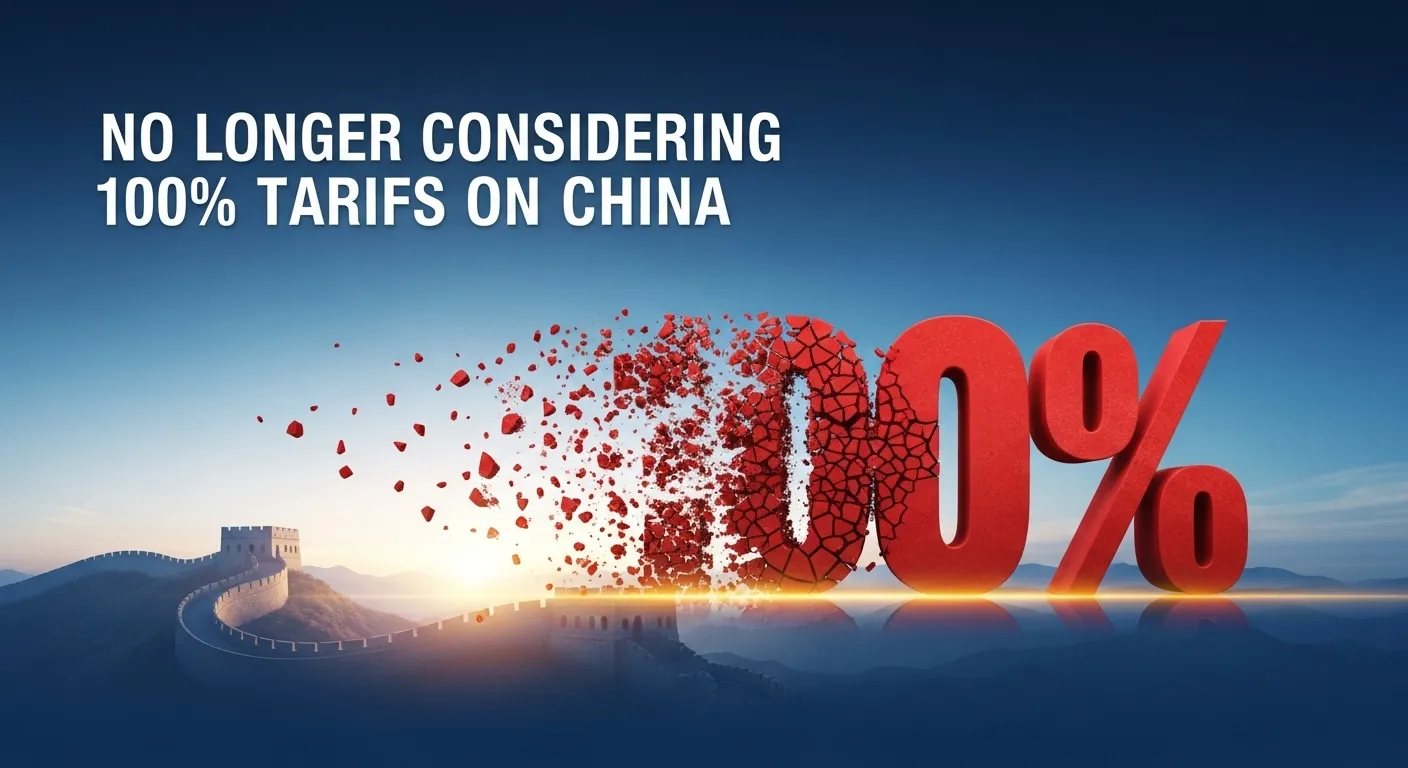
US Treasury Secretary Says: No Longer Considering 100% Tariffs on China

The latest round of US-China trade talks concluded on October 26 in Kuala Lumpur, Malaysia, after two days of intense negotiations. Both sides held discussions guided by the recent consensus reached by the two national leaders. Topics included the 301 measures on maritime logistics and shipbuilding, the extension of reciprocal tariff suspension, fentanyl-related tariffs and enforcement cooperation, agricultural trade, and export controls.

Officials described the dialogue as frank, in-depth, and constructive. Both sides reached a preliminary consensus on resolving key concerns and agreed to finalize the details through domestic approval procedures. Analysts from both countries called the outcome a positive step forward.

Constructive Progress in Kuala Lumpur

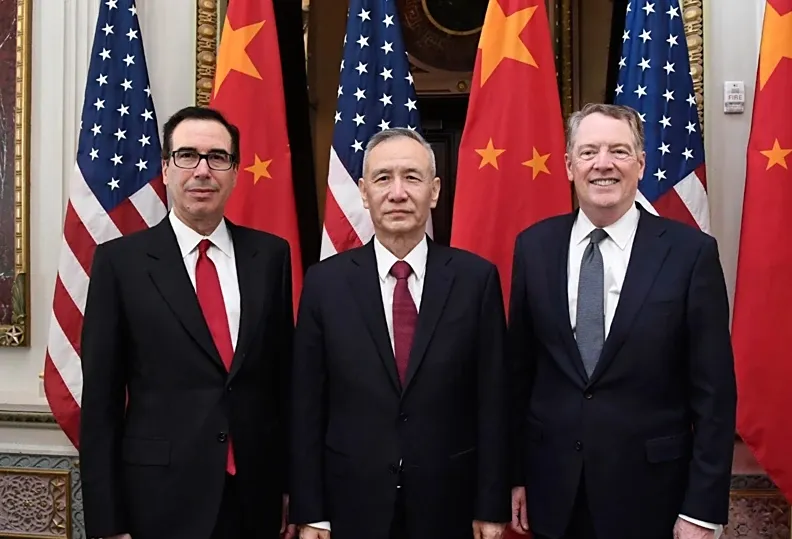
From October 25 to 26, Chinese Vice Premier He Lifeng led the Chinese delegation, while the U.S. side was represented by Treasury Secretary Besant and Trade Representative Greer. He Lifeng emphasized that the US-China economic relationship is fundamentally mutually beneficial. He noted that cooperation benefits both nations, while confrontation harms both. Maintaining stable trade relations, he said, aligns with the interests of both peoples and meets global expectations.

He added that differences should be handled through dialogue and respect, not confrontation. The U.S. delegation responded that it views US-China trade relations as the most influential bilateral relationship in the world and expressed its willingness to cooperate with China in a respectful and equal manner.

A Framework for Future Cooperation

According to Singapore’s Lianhe Zaobao, the trade teams met for over five and a half hours on the first day and continued discussions the following morning. Chinese Vice Minister Li Chenggang later revealed that the agenda covered many issues, including export controls, tariff suspension extensions, fentanyl cooperation, trade expansion, and maritime industry fees under the U.S. Section 301 measures.

After a day and a half of talks, both sides reached a constructive preliminary consensus. The next step, Li said, would be for each side to complete internal approval procedures.

U.S. officials echoed this optimism. Treasury Secretary Besant said the two countries had established a “highly successful framework” that would help pave the way for a potential leaders’ meeting. U.S. Trade Representative Greer added that discussions had been productive, covering tariffs, rare earths, and a possible trade agreement proposal ready for review by the two heads of state.

While attending the ASEAN Summit in Kuala Lumpur, President Donald Trump told reporters he was confident about reaching a comprehensive deal with China.

“Tensions Have Eased”

According to Reuters, this was the fifth face-to-face meeting between the two trade teams since May. After the talks, Besant told U.S. media that the sides had reached a “substantial framework agreement” and that the U.S. was no longer considering 100% tariffs on China.

The South China Morning Post commented that the results marked a significant easing of tensions between the world’s two largest economies. The current reciprocal tariff suspension period will expire on November 10, making the progress even more meaningful.

Zhou Mi, a researcher from China’s Academy of International Trade and Economic Cooperation, said both sides engaged in tough bargaining but achieved effective results. The talks, he noted, were constructive, wide-ranging, and mutually beneficial. Whether this progress can lead to a formal written agreement, he added, remains to be seen. However, the outcome sends a strong positive signal for global markets.

APEC Summit Could Shape the Next Stage

Observers linked these US-China trade talks to the upcoming APEC Summit, which will be held in Gyeongju, South Korea, from October 30 to November 1. President Xi Jinping will attend the meeting and make a state visit to South Korea, while President Trump has also confirmed his visit.

South Korean media outlets highlighted the global anticipation surrounding a potential Xi-Trump meeting. The Dong-A Ilbo reported that this would be the first time in history that both U.S. and Chinese leaders visit South Korea simultaneously. Analysts believe such a meeting could determine whether the current tariff truce continues or ends, shaping the future of U.S.-China competition.

The upcoming summit will focus on “Connectivity, Innovation, and Prosperity.” South Korean business leaders, including SK Group Chairman Chey Tae-won, emphasized that the APEC gathering will serve as a barometer for U.S.-China relations. He said the world has moved beyond the era of unrestrained free trade and must now navigate new trade barriers and evolving global supply chains.

China Reaffirms Its Openness

On October 24, Chinese Ambassador to the United States Xie Feng addressed American audiences about China’s future direction following the Fourth Plenary Session of the 20th CPC Central Committee. He stressed that China will continue to embrace globalization and expand its openness despite protectionist trends.

“Small yards and high walls,” he said, “cannot stop China’s progress.” He reaffirmed China’s commitment to multilateralism, reform, and shared global growth.